Showing posts with label Jean Isaacs. Show all posts

Monday, September 26, 2016

Trolley Dancin' from Barrio Logan to Fault Line Park

This year's Trolley Dances returned to Barrio Logan but with new twists and outbound visits to the Museum of Contemporary Art downtown and then on to Fault Line Park.  The Trolley Dances continues the emerging San Diego culture - a thank you is owed to Jean Isaacs and the San Diego Dance Theater.

What always fascinates me is thinking about dance and the variety of spaces in which they are performed.  This is not your usual theater performance and not simply outdoors.  There is a connection between the choreographer's concept, the musical framing of the dance, and how the dancers engage with each other and the venue. 

I've included two short videos that provide a bridge from these still images and the performance itself. 

Hopefully you find the time to explore these dances as well as the re-invigorated Barrio Logan community and travel with them to the Museum of Contemporary Art as well as to the lesser known (to me) Fault Line Park.

Me and My Car, choreographer Jean Isaacs with Minaqua McPherson and JT Magee
The choreographer's concept:  "Ever think how much people resemble their cars? .  .  .  My car has 214,000 miles on it and runs great despite its many scratches and dents - just like me. We are dancing in and on our cars on the 4th level of the parking structure .  .  .  . "

Me and My Car

Video excerpt from Me and My Car


Follow Us Here, Choreographer Jess Humphrey
The choreographer's concept:  "Behold, follow, leave, or find any dancer or dance you wish throughout this site-sensitive performance."


When: October 1 and 2, 2016
Tour Times: 10:00, 10:45, 11:30, 12:15, 1:00, 1:45

Where: Begins at San Diego Continuing Education CĂ©sar E. ChĂ¡vez Campus Parking Garage
1902 National Avenue, corner of Cesar Chavez Parkway 
Trolley Dances brings original site-specific dances to the MTS Blue Line starting in the historic Barrio Logan and winding through the heart of San Diego ending at Fault Line Park, all led by trained tour guides. A stellar team of choreographers are on board to create newwork that is sure to delight and engage.
 
Site locations: 
CĂ©sar E. ChĂ¡vez Campus Parking Garage
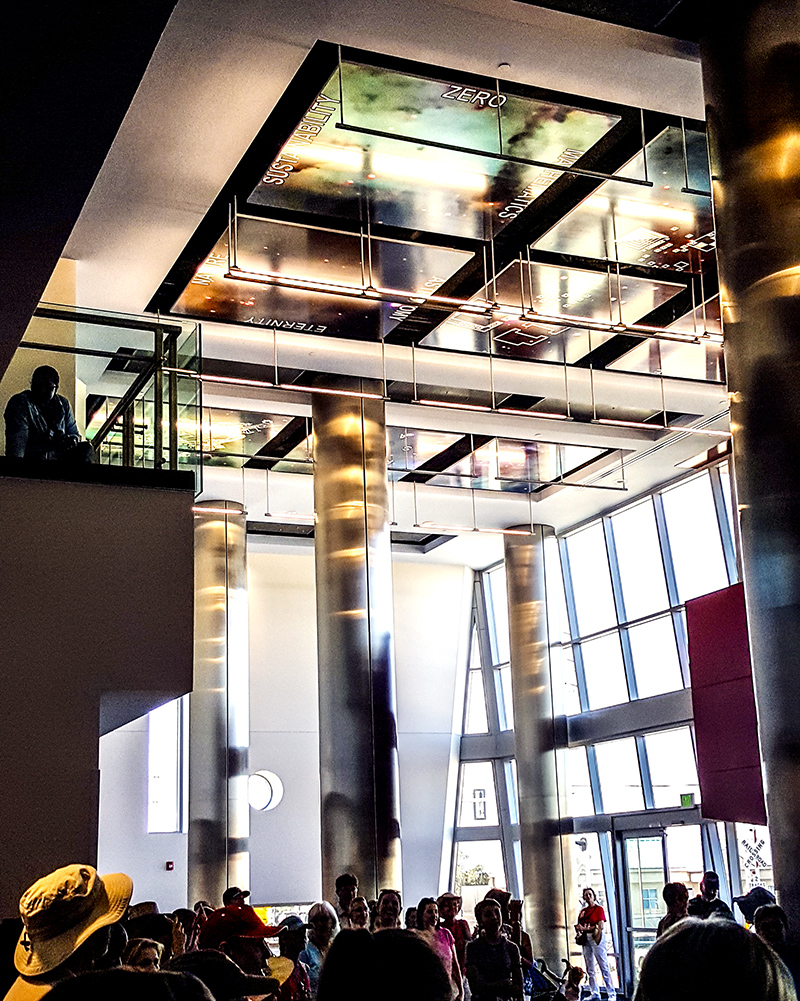
Lobby of the SD Continuing Education CĂ©sar E. ChĂ¡vez Campus Museum of Contemporary Art

Walkway across from MOCA
Fault Line Park


Follow Us Here

attempts to define, Choreographer Zaquia Mahler Salinas, in collaboration with the dancers
The choreographer's concept:  "This dance is inspired by the beauty in individual expression of identity and history. Art is a radical expression of humanity that lies at the root of the Chicano art displayed in this space and at the heart of this dance."

[Note: I am reminded of my long ago documenting and exploring the notion of Chicano identity: “Some Notes on Chicano Music as a Pathway to Community Identity,” in New Scholar 5,1:73-93. (1975)]

attempts to define

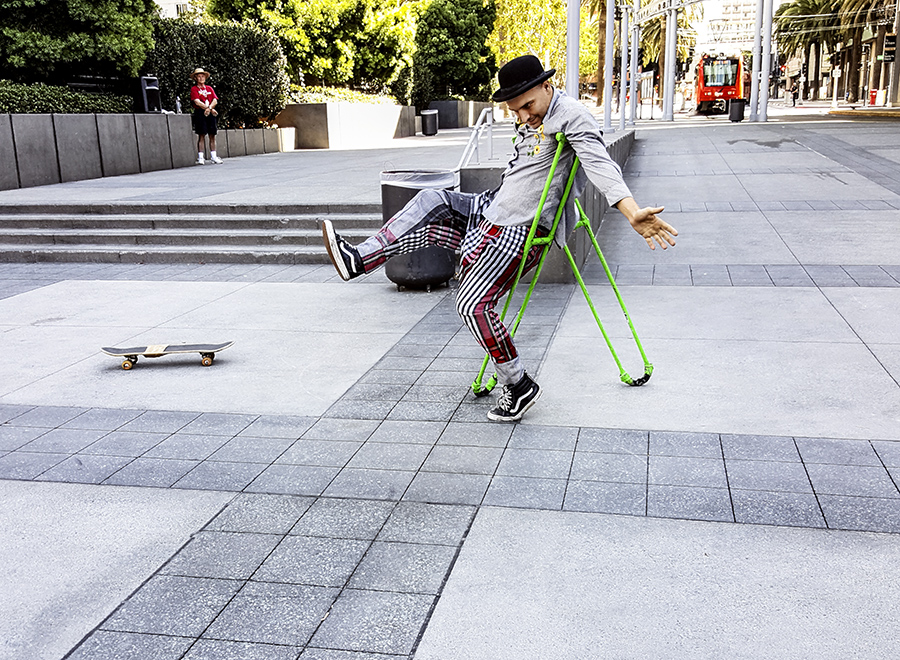
Finding Center, Choreographer Bill Shannon
The choreographer's concept:  "Inhabiting a square anywhere in the world involves the same basic patterns of physical behavior as my practice defines it: To claim the center of a given square one need first define its edges. Working with non-verbal relationships relating to human patterns I might choose to define my edges as counter to the sociological constructs that predetermine the definition of a place. I might submit to or contest the power of architecture. Even the shadow cast from a building carries a different mood than the shadows cast from a tree. This dance is a question with no right answers."


Up a Creek with Ten Paddles, Choreographer Jean Isaacs, with input from the dancers
The choreographer's concept: "Inspired by a television ad for an insurance company in which a man rows on escalators, lawns and in canoes, this piece was created for the northwest corner of Fault Line Park and is extremely site-specific, meaning we could never perform it anywhere else without major reconstruction."


Tonight's Game, Choreographer Monica Bill Barnes
The choreographer's concept: "There are a few things that you may not know about this dance, this lawn is one of the most popular dog parks in the city and therefore full of dog poop so please watch your step. Also, there are small black flies that bite the dancers' ankles, even through their socks. A few of the dancers are allergic to grass. . . ."


Tonight's Game

Reflective Globe at Fault Line Park


Monday, September 28, 2015

Embracing the Centennial in Balboa Park: Trolley Dances and the Digital Art Guild

The San Diego Union Tribune featured 100 stories about Balboa Park to illustrate the 100 years (and memories) of the Park. 

I'm not sure whether other media have chimed in on what makes this Centennial special. Not to mention that we have three months left in the year. There are many other worthy events that add to the Centennial celebration. 

I mention only two. I invite you to add your own nominees to this bouquet of provocative and imaginative displays.

At this time of year in San Diego, we are inspired by the San Diego Dance Theater's Trolley Dances. And this year, nearly all of the dances are in Balboa Park -- from the Zoo Centennial Walkway and Spanish Village to the famous Moreton Bay Fig Tree and the Mingei Museum.


Jill Rowe / Immigrants / featured in the Digital Art Guild's exhibit at Gallery 21
Trolley Dances at Spanish Village / Balboa Park / Back to Front / Choreographer: Mark Haim
The Trolley Dances appearance in Balboa Park certainly qualifies it as the 101st memory - spontaneity, creative use of park space both in open areas as well as in the Mingei Museum, performance in favorite places, and surprise.

The Trolley Dances performed for two weekends - at the end of September and the beginning of October - beginning at the San Diego County Waterfront Park and ending at the Mingei Museum in Balboa Park.

Trolley Dances

The Trolley Dances, performed by the San Diego Dance Theater, has been part of San Diego's cultural landscape now in its 17th annual season.  The concept embraces the urban environment: "Bring dance to the people using public transportation and introduce audiences to new neighborhoods and experiences." 
 
Trolley Dances at San Diego Zoo Centennial Walkway / Balboa Park /  Become Ocean / Choreographer: Jean Isaacs

Trolley Dance at Moreton Bay Fig Tree / Balboa Park /  Roots, Soul, and Love! / Choreographer: Suzanne Forbes-Vierling

Trolley Dances at the Mingei Museum / Balboa Park /  Giving Way / Choreographer: Anne Gehman
And more:  The Trolley Dances at the Waterfront

The dances take the audience to different locations to experience the dances in a variety of urban contexts. This year the starting point was the San Diego County's Waterfront Park (which was formerly two large parking lots on either side of the County Administration building).

Trolley Dances at San Diego County Water Front Park, North Fountain Reflecting Pool / Play(as):  Choreographer: Stephan Koplowitz

Trolley Dances at County Waterfront Park / Blue Stillness / Choreographer: Liv Isaacs-Nollet

If one digs back into the history of Balboa Park, back to 1915-16, one can see the spirit of fanciful design already at work. A.J. Roberts' painted a gondola-filled lagoon with the Park's memorable bridge and California Tower in the background. The painting is now on exhibition at the San Diego History Center. 

That same sense of imagination is reflected in the 102nd memory of the Balboa Park Centennial - the Digital Art Guild's Looking Back, Looking Forward exhibit opening on November 4th at Gallery 21 in Spanish Village.


Digital Art Guild at Gallery 21/Spanish Village

What makes Balboa Park special? Yes, there are the institutional museums, theaters and amazing outdoor organ pavilion.

But there are those smaller niche spaces that invite discovery for the millions that come to the park.

One of those spaces is Spanish Village. Amongst the individual artist studios is Gallery 21. This space hosts a variety of art groups and individual artists - part of an annual juried process.

The Digital Art Guild considered how its exhibit might celebrate Balboa Park's Centennial. There are parks on Alpha Centauri (yes, digital art was borne of varied interests including fantasy and sci-fi, but also ways of reinventing traditional art styles).
  
How best to keep an open mind about the park? The Guild decided on a theme of looking forward, looking back - providing a sense of continuity from the deep past into the unknown future.

Looking Back, Looking Forward provokes the visitor to imagine what the park has been, what it is and what it might be.

The Digital Art Guild exhibit runs from November 4 to November 16, 2015.   

Open daily from 11 am to 4 pm. Artist reception, Saturday, November 7th from noon to 4 pm.

Tony Velez / Games of Emotion (Left) / John Valois / Park Muse (Right)

What comes to mind for a digital artist? Perhaps not that different from what many artists experience - though the tools and style may.

Tony Velez speaks for many of us:   "I am passionate about light, color, nature, music, and love. The artwork that I create is balanced against the hectic pace of my work and reflects my own personal journey of soul recovery and spiritual development. An unusual life creates an unusual artist. I take chances and ask you to feel something inside as you reflect on my pieces. I love what I do.  .  ."


Robert Pendleton / Wish You Were Here  (Upper); Charlie Anne Breese / Spinning Fire (Lower)

Richard ChauDavis with ACE / I See You (Left); Ron Belanger / Bowling at New Balboa Park (Right)
Having been a digital artist for more than a dozen years, I have been thinking about extending 2D flat images - those paintings, prints and photographs - into the ever popular dance video. Over the past six months or so, I've produced two such videos (yes, with much help from others). Both deal with the Genesis story about the first man and first woman. We are quick to say Adam and Eve, but there are myths about another woman before Eve, namely, Lilith. I've played with a conversation between Eve and Lilith - sometimes with Adam and sometimes without. Both videos will be shown at the Looking Back, Looking Forward exhibit. 

You might wonder whether I've taken more poetic license than I should:  Isn't this exhibit about Balboa Park?  Well, for us, that is our own Eden, our own Garden. We can only imagine what happened on these grounds before and the conversations that emerged.

Joe Nalven / What Becomes Eden (premiere) / screen shot of dance video at Gallery 21
 

Monday, January 12, 2015

Jean Isaacs’ Dances of Love, Laughter & Loss at UCSD Mandell Weiss Theatre

By Joe Nalven


A dance inspired by “The Atlantic Man.” 

What better way to restart the new year than to visit with Jean Isaacs Dance Theater. The performances are always delightful and create a sense of wonder in how she combines literary themes with modern dance.

The first of two dance sets is based on Marguerite Duras’ radio play, “The Atlantic Man.” It was first presented at the California Center for the Arts in Escondido in 2003 and now is being re-staged at the Mandell Weiss Theatre on the UC San Diego campus.


A reflective Jean Isaacs

Jean Isaacs’ choreography weaves the dance movements around the notions of love and loss. As she explained it:   
“The Atlantic Man’s central theme is how absence of a loved one is made more painful by knowing they were here and knowing that the moment will pass. “The Atlantic Man” metaphor is visualized as the birds he has seen at the beginning of the dance. Of course, taking the imagery and the play’s text and how it is choreographed as dance oversimplifies the performance and might even take away some of its magic. Much better to see the performance.”

One gets a sense of how this magic works by how the dance unfolds for one of the dancers. Erica Nordin danced in the first staging of the play in 2003:

“There is a lot of bird imagery used in Atlantic Man, and there are moments when we move as a flock onstage or channel a birdlike quality to get Jean’s direction across. We were given the idea of fullness versus emptiness. You can see this when one partner moves away from another and the one left behind somehow registers the emptiness energetically in their body. Personally, I look for a somewhat intense or intimate connection with my fellow dancers, to the beauty and tone of the music, and to the text of the piece. I allow it to be its own world and experience from start to finish each time.”


The second part of the program is “Pillow: Case.” The series of dance vignettes looks at love with cheeky mindfulness. You will laugh and you will smile. It is a world premiere using Meagan Marshall’s narrative. The key props in these dances are old pillow cases. They carry the memories of those who’ve slept on them.


From The “Pillow: Case” dance

Ariana Siegel provides the following insight: “The piece uses seemingly mundane objects — worn out relics, pillow cases — to meaningfully link people, experiences, and time. As a dancer, I open the linen closet door and blow dust off certain pillow cases. I slip down a nonlinear memory lane, meeting old ghosts, breathing life into them, and letting them dance together.”


From The “Pillow: Case” dance


From The “Pillow: Case” dance

Erica Nordin dances in the Pillow: Case as well: “Bringing about Jean’s ideas in some of the lighter pieces involves an aspect of physical comedy. I have to let go of any insecurities about looking the fool onstage. You really have to make where you’re coming from seem authentic to get the laugh across.”

Jean Isaacs is one of San Diego’s cultural treasures. Think about it. Go see the “Dances of Love, Laughter & Loss.”

· “Dances of Love, Laughter & Loss” at the Mandell Weiss Theatre at 2910 La Jolla Village Dr. on the UC San Diego campus

· Performances Friday and Saturday, Jan. 16-17, at at 8 p.m., and Sunday, Jan. 18, at 2 p.m.

· Tickets are available online at sddtlovelaughterloss.brownpapertickets.com

A group pose


This article was originally published in the Times of San Diego.