In the year of Balboa Park’s Centennial, the many museums and activity centers located there are finding ways to reflect on the park’s past and wonder about its future.
A Point of Departure: Visual Fine Art - Then and Now
I’d like to suggest a comparison for its immediacy. Consider Will Given’s 2015 photograph, Echoes, with the prize winning painting by William Wendt, Mountain Infinity, at the Panama–California Exposition in 1915.
In 1915, photography was made for more for picture postcards and the daily papers - even with the exhibition including a separate section for fine art photography in the Fine Arts Building.
Over the past century, photography has become an important medium in the visual fine arts and has experienced major technological transformations, particularly digital capture and digital editing. Given’s photograph, Echoes, embodies high resolution digital photography (mirrorless full frame Sony a7r digital camera that produces a 36.4 megapixel image with multiple images composited in studio); Givens also picks a modern theme of time and memory, with an after image creating a metaphor of the mind’s stuttering attempt to locate the object in time. Think of the movie Inception!
 |
Will Given, Echoes
"The goal for Echoes is to show how through Balboa’s 100-year history. It is the constant that unites us all, even across temporal space. It is
the place that allows us to feel a connection to our past, and to envision our
own future when we are able to share the experience of the park with
generations yet to come. It is a place where memory and nostalgia blend
with the active engagement of progress. It is a place where we can look
to the future in excitement over what the next 100 years will bring."
|
William Wendt’s painting, Mountain Infinity, captures a different California mood – of landscape, the outdoors and a spiritual connection found more in nature than the urban metropolis.
Although Anthony Anderson's description in the Los Angeles Times (1911) is of Wendt's painting Topanga, one could easily apply it to Mountain Infinity. "[It is] with the perfect understanding that comes from perfect love. In his pictures of this wonderful canyon the very spirit of the out-of-doors and also -- what is equally to the point -- the very soul of Southern California, is felt." [Cited in William Wendt: Plein Air Painter of California by Will South]
| William Wendt / Mountain Infinity, Grand Prize Winner at California Exposition, 1915 (L); |
W.E. Averett / Picture Postcard, Aerial Photo of Panama-California Exposition, 1915 (R)
Curating a Contemporary Mindset: The San Diego Art Institute's Exhibit - San Diego Keeps Her Promise: Balboa Park at 100
The San Diego Art Institute (SDAI) houses multiple exhibits of contemporary art thoughout the year. Located in the House of Charm that was originally the Indian Arts Building, SDAI captures the many-faceted ways in which artists compose the world. This exhibit - San Diego Keeps Her Promise - is no different: Balboa Park is visualized, textured, heard and sensed with the fragrances of the area.
I've taken a sample of the artwork to illustrate how Balboa Park has been imagined in these various ways. Needless to add, go and see the exhibit to enjoy the full range of this past, present and imagined perspectives of Balboa Park.
A Sentiment Worth Sharing
Kathleen Kane-Murrell's Crossing Bridge evokes the sentiment that one enjoys in visiting Balboa Park. Kane-Murrell sees her images of this place capturing what William Wendt capured in his work some 100 years ago. "Someone recently said to me there is a spiritual nature to this place."
Not quite the landscape of Julian or the Anza-Borrego Desert, but an urban retreat. Presumably that's what a good park conveys.
 |
| Kathleen Kane-Murrell / Crossing Bridge |
"For 'Crossing Cabrillo in 2015' I used the materials common to me as an art teacher
for children- crayon, paper, pencil, collage and acrylic paint. I embedded images
and words from the Union Tribune’s last publication of 2014. I was struck by many
things but in particular the lack of women listed as noteworthy in the last
year. One hundred years ago in San Diego
women marched with banners that said, “I am a Person.” In 2015 women still ask
to be recognized for who they are and what they contribute. I can’t help but imagine how this landscape
might change in the next hundred years."
Textured Perspectives - More than Sight: Sound, Smell, Stitching and a Walkabout
How do we explore Balboa Park with all five senses? Many of us favor the Prado Restaurant for taste - and why not! But what about those other senses? How do we build those into a fine art perspective?
Brian Goeltzenleuchter and Charmaine Banach
One way to experience the Park is to do a walkabout with a map. Goeltzenleuchter and Banach printed 2000 maps of the Park that takes you on an interesting and unsual tour. The legend marks the following landmarks - each with its own story:
The Pheromone Story - Next to the Carousel
The Date Story - In Front of the Botanical Building
The Drug Story - North of Pepper Grove Playground
The Basketball Story - In the Municipal Gym
The Lily Pond Story - Near the Lily Pond
The Grandma Story - Between the Cactus Garden and the Rose Garden
Goeltzenleuchter summarizes this art work "as an art walk which uses locative media, olfactory art, digital audio and printed ephemera to take the participant on a narrative journey through Balboa Park."
 |
| Brian
Goeltzenleuchter and Charmaine Banach / Balboa Stories / Park Map with Landmarks and Stories |
San Diegans were asked if they had smell memories of Balboa Park - the sense of smell being a powerful memory trigger. The stories the San Diegans told were intimate, and often strange, slices of life: a perverse sports injury, a blissed-out drug trip, a romantic tryst gone awry. As opposed to taking a historical tone these stories are more like something you overhear at a bar - fish stories and shaggy dog stories. We preserved the stories’ spoken word form by digitally recording the narrative as told by the person who experienced it.
Cat Chiu Phillips
In days gone by, inspiring locations would be visualized on tapestries. Late Medieval and Renaissance churches and castles were home to decorative weavings that presented large figurative images.
Cat Chiu Phillips work are not replicas of those historical tapestries, but one can sense the mix of textile and paper as echoing that sense of grandness and the importance of architectural figure. Her larger installations can be found at the San Diego Airport in Terminal 2. At SDAI, the smaller paper works are her artist proofs/sketche; the more intimate presentation should be equally compelling.
 |
| Cat Chiu Phillips / St.
Francis Chapel / Mixed media with
embroidery |
"I have created works on paper focusing on the seven historical landmarks that have become permanent structures from the 1915 Panama Exposition. This includes the Cabrillo Bridge, Botanical Building, Spreckels Pavilion, California State Building (now part of Museum of Man), Chapel of St. Francis, Fine Arts Building, and the California Bell Tower. Each work is on paper and layered with archival images from the 1915 Exposition along with modern day informational handouts; each one is stitched together with architectural details from each respective structure. This juxtaposition invites the viewer to see each landmark's historical richness, cultural significance, and aesthetic timeless appeal."
Franciso Eme
Francisco Eme takes the Park as a series of milieux that influence us - in sight and sound. He composites his own impressions as a video and soundscape.
The first time I visited Balboa Park I was surprised to see that its architecture had a lot of Mexican and Spanish influences. That same day I made an audio recording of an American teenager musical trio that was playing a Mexican bolero called “Amor de mis amores” outside the San Diego Museum of Art. The message was clear, Balboa Park is a multicultural place. Along the day I kept recording audio finding a musical duo (Asian and Afroamerican musicians) playing “Cielito Lindo” a Mexican folk song on a steelpan, a musical instrument originated from Trinidad y Tobago. Later the same day I went to the spot where you can see and hear airplanes so close because they are about to land, so they fly just above your head so I recorded that too. All on my very first day.
On my next visits to Balboa Park the impressions kept strengthening, finding musicians playing Didjeridoo, American folk, and a lot of different kinds of music from all around the world. So I kept recording. When listening to my recordings I found out that the soundscapes included phrases in many languages, the visitors of Balboa Park come from different countries too. Maybe because of California´s history (that once was a Mexican territory) and San Diego´s condition in the present as a border city, I think this mixture of cultures is natural. Later, when reading about Balboa Park´s history I discovered that its architecture was influenced by many Mexican colonial buildings and suddenly everything was clear to me. There is a reciprocity: the geography, the history and the people influenced Balboa Park´s architecture, and 100 years later the architecture influences the people and everything that happens in there.
Architectural voice is a multimedia composition for 5.1 audio channels and 1 video. The video part contains images taken from the original Balboa´s 1914 architectural blueprints, while the musical part is constructed from audio recordings of Balboa Park I have been doing for some months, including a lot of different musicians and soundscapes. I call Architectural Voice to those sounds that emerge from the human-architectural interaction. One hundred years after its creation, this is the Architectural Voice of Balboa Park.
Connecting the Memory Dots
Over the past century plus, the most common way for us to connect our personal histories is with photographs. There was the Brownie Hawkeye and now cell phone cameras. Snap, snap, snap. Shoeboxes filled with family photos have given away to file folders on our computers. The photograph is the material side of holding on to our memories.
Paul Turounet also works with memory - cultural and personal. His approach is photographic, both contemporary and historical, and seeks the ‘normal’ in how Balboa Park was and is: “The photograph and picture postcard, front and back provides a narrative vignette to consider Balboa Park in relationship to our sense of memory and culture, collapsing our understanding of time and history from 1915 to 2015.”
Indeed, a melancholy imagery.
 |
| Paul Turounet / A
Land That Makes Men Kind (excerpt) / an
ongoing suite of vintage postcards from 1915 of the Panama - California
Exposition and photographs from 2015 of Balboa Park |
The Radical Departure: Digital Reflections
Photography has had a bumpy road to acceptance as a fine art. Similarly, digital art - or contemporary art in digital media - has had a reluctant acceptance outside of digital cameras, FX movies and most of commercial photography. But what better way to conceptualize the future and alternative realities than with the playground of digital media.
Vincent Mattina has selected one of the most photographer locations in Balboa Park - the reflecting pool in front of the arboretum. Mattina's surrealism follows the grand tradition of Salvador Dali in bending reality, but with the toolsets common to digital media - whether photographic, painting or other techniques.
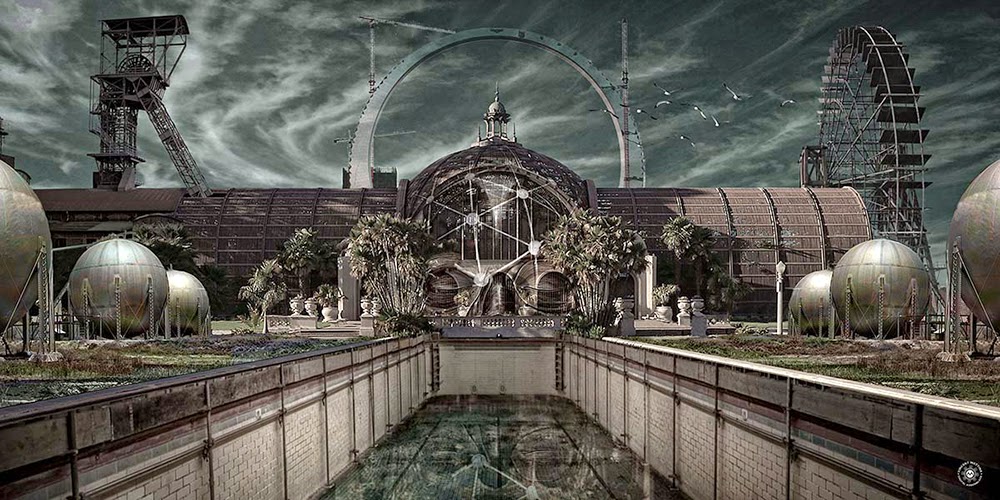 |
Vincent Mattina / Arboretum Hours
"My images convey a post-apocalyptic setting within Balboa Park perhaps 100 years from now. Although the images may appear as a melancholy epitaph to our current view, the viewer may see a ray of hope at the end of mankind's weary journey."
An alternative approach to surrealism and sci-fi is the hyper real technique that can fool the eye. Collaging a faux reality can present a problem for the unwary, but used in a transparent way such faux realities can provoke laughter and wonder. This image represents a park reality that could be true given the fascination with green technology, energy saving programs and a dubious water supply.
|
 |
Joe Nalven / Sustainable Plaza
"If sustainability was really implemented at the Park, the aesthetic view would yield to views of functional energy and water technology. Perhaps, too, there is a hidden sign telling the public that the potable water they drink has been recycled."
|
January 23 through February 22, 2015
San Diego Art Institute
1439 El Prado, Balboa Park
San Diego, California 92101
Hours:
Tuesday - Saturday
10am to 4pm
Sunday 12 noon to 4pm
Closed Mondays and major holidays
Tel: 619-236-0011
|
And then there was the nudist colony . . .
San Diego is no stranger to outdoor bathing au naturel. Its Black's Beach has had an up and down history with acceptance by local (now prohibited) and state authorities (allowed). Trip Advisor still carries a page about the success of clothing optional swimming.
The challenge for an artist focusing on public nudity is how to capture this mindset - something more than what is available on the internet, the movies and cable TV.
The 1935 - 1936 Pacific International Exposition in Balboa Park featured a nudist colony (actually hired performers) in what is now the Zoro Butterfly Garden. The outdoor attraction was the best money maker and was billed as a place to see "[h]ealthy young men and women, indulging in the freedom of outdoor living in which they so devoutly believe, [and] opened their colony to the friendly, curious gaze of the public." [From David Marshall's San Diego's Balboa Park. See also David Marshall and Iris Engstrand, Pictorial Essay.]
Saulo Cisneros's video installation combines the place (Zoro Garden Nudist Colony) with the photographic approach of Eadweard Muybridge: "I am not trying to recreate reality. What I am doing is to create moving scenes with series of still images. It is a homage to both Muybridge and to the nudist colony."
.jpg) |
| Saul Cisneros / The Zoro Garden Nudist Colony reimagined through
Muybridge / Muybridge image (L); installed video at the rear (R) |
"The video installation is called The Zoro Garden Nudist Colony reimagined through Muybridge. It is a video composed of animated photographies of the Eadweard Muybridge motion studies that reimagines (at this time and space) how individuals would have been hanging around at the nudist colony. The video is projected onto three layered translucid banners that measure 5' x 10' giving the video a three dimensional, but also a ghostly, texture. You can appreciate the piece from any side (so the projector shines onto you). You can see the projection with a visual overlapping of the SDAI crowd (which are the people that frequent Balboa Park at the present)."
And a reminder of gunboat diplomacy . . .
Carlos Castro Arias’ presentation is a story about the U.S.
and President Theodore Roosevelt’s taking over the French attempt to
construct the Panama Canal. The French effort collapsed due to engineering
difficulties and the high mortality due to malaria and yellow fever. The
building of the canal was first proposed in 1534 by Charles V with the Spanish
considering an easy way to voyage between the Atlantic and Pacific
Oceans. Scotland attempted an overland route in 1698. The Panama Railway opened
in 1855. The U.S. negotiated a treaty with Colombia in 1903 to take over the canal
project but the Colombian Senate failed to ratify it. The U.S. then threw its
support to Panamanian rebels and the U.S. benefitted from the formation of a
new country. This was an example of U.S. gunboat
diplomacy at that time. It should be
noted that a large part of South America that had been known as Gran Colombia
(Venezuela, Colombia, Panama, Ecuador and parts of other countries) could have
been a major counterpoint to the United States, but it fell apart in 1831. The
question lingers why South America failed to have the success that the United
States had with an equal amount of natural resources.
Arias’ artwork and story emphasizes
the U.S.’s dominant influence in the region, but the reasons for the failure of Latin America to achieve a similar success go back to earlier than U.S. dominance for the difficulties
of Latin American regional integration. Also of note, the Nicaragua Canal – a route considered by the
U.S. and others – was approved in 2013 in collaboration with Hong Kong.
However, questions continue whether the financing is secure.
 |
Carlos Castro Arias / Other Stories
1915’s Panama - California Exposition commemorates the construction of the Panama Canal at the same time that Balboa Park was founded. At the same time, the Exposition is a memorial of a theft. Panama was part of Colombia until in 1903 when it was proclaimed independent after the intervention of the United States so they could build and own Panama’s canal for 85 years. Through the use appropriation of historical images, re-contextualization of objects and humor, the project Other Stories is conceived as an investigation and a creative inquiry about human condition in the Americas. |
Each artist has crafted a distinct imagined park - as would be expected. But taken together, the exhibit offers a concept within a memory of what was and what could be.
Participating artists: Carlos Castro Arias, Cat Chiu Phillips, Saulo Cisneros, Kate Clark & Hermione Spriggs, Francisco Eme, Ruben Franco Notch, Dave Ghilarducci, Will Given, Brian Goeltzenleuchter & Charmaine Banach, Jasna Gopic, Beliz Iristay, Vincent Mattina, Kathleen Kane-Murrell, Diego Leon, Chuck McPherson, Joe Nalven, Denise Strahm, Paul Turounet, Scott Polach, Bianca Romani, Suzanne Thorpe, and Alex Young.
Notes:
I was intrigued by Francisco Eme's reference to the song, Amor de mis amores. There are a number of YouTube covers, but my favorite is one by Melissa Robles.
Joe Nalven is a Board member of the San Diego Art Institute.
A thank you to Will Givens for information about the present of photography at the Fine Arts Building (1915 Exposition).


