Showing posts with label visual art. Show all posts

Tuesday, March 31, 2015

The Son Reflects the Father: Mario Torero talks about Guillermo Acevedo's Art at the San Diego Airport

It is not uncommon to find parents who were painters and their children likewise: N.C. Wyeth - Andrew Wyeth – Jamie Wyeth (U.S.); Orazio Gentileschi - Artemisia Gentileschi (Italian); Jean Cousin the Elder – Jean Cousin the Younger (French); George Ward – Henrietta Ward (British); Bjorn Egeli – Peter Egeli – Lisa Egeli (Norway to U.S.); and so on.
So, too, in San Diego, Mario Torero follows in the footsteps of his father, Guillermo Acevedo.
Guillermo Acevedo (1920-1988) moved to San Diego in 1959 from Arequipa, Peru. He became interested in San Diego’s Victorian homes, the waterfront, Balboa Park, Santa Fe Depot and its neighborhoods. His work influenced the interest in saving historic buildings and became involved in the forming of San Diego's Save Our Heritage Organisation.  Acevedo began promoting his work in Balboa Park art-marts and later opened his own art gallery in downtown San Diego, later moving it to the Mission Hills area. He is credited with being one of the first recognized Latin American artists in Southern California in the 1970s. Acevedo lent his support to the establishment of the Centro Cultural de la Raza (considered part of the radical protest movements of the 1960s) and inspiring the new generation of Chicano artists.  Among those new Chicano artists was his son Mario Torero.
Guillermo Acevedo / Historic buildings, San Diego
The San Diego Airport Authority has honored Acevedo’s work in its recent unveiling of its year-long rotation of artists in addition to its permanent collection.  Visitors to Terminal 1 and Terminal 2 will discover these works on the walls, on the ceilings, at various alcoves and even a meditation room.
The Airport Authority holds an open competition for siting new work.
Mario Torero, Acevedo’s son, and also a landmark painter in San Diego, decided to apply to memorialize his father’s work.
Joe Nalven: So how did this airport exhibit of your father's work happen? Were you surprised to hear back from them when you applied?
Mario Torero:  Everything was perfect timing. When I heard about the application, I was in the midst of researching my father's work for a book about his work with Marianne Peterson. Perhaps if I hadn't been working on the book, I might not have applied. His spirit is more alive at this moment, especially with his place in San Diego history with the Balboa Park Centennial.
I was surprised when I heard back from the airport and the interest in my dad's work. It took awhile but I know when things are right. Their curator, Lauren Lockhart, was very enthusiastic. She started coming over and said he would be in their gallery.
Guillermo Acevedo / Bending Electricity
Joe Nalven:  Do you see him in your work?
Mario Torero:  I sense that I am connected to him spiritually and thinking about what comes next; it will be a surprise. People might think I'm crazy. Mario used to be here; but now I'm Guillermo. He's living his life in me. His spirit is coming into my blood; a recycling is going on. I want to believe that. I'm thinking about the Getty, but it wouldn't be just me, it would be him too.
Terminal 1 Bridge / Looking down on cars, looking across at Guillermo Acevedo's illustrations
Terminal 1 Bridge / Looking up at window images about Balboa Park and Guillermo Acevedo's illustrations
Joe Nalven: What memories of your father would bring him to life for us?
Mario Torero:  As part of the Centennial, I want to recreate an image of him sitting on the bench drawing.  But looking back to my memories of him, it would always be a happy situation. When you knock on the door of his house and he opens the door, everyone who walks in, there's a feeling of happiness. Artists would come in, bring a guitar and wine. He would come back from Balboa Park with artists from other places, from Argentina, Romanian, Russian, wherever. The entire family. Some were gypsies; I thought we were gypsies.

Other artists would see him as a star. He's quoted in the paper and he's at the exhibits. The impact he gives, the way he dresses, he stands out. He always wore hats. Just like I do. And he would ask questions that would need to be asked - when others weren't asking them. For some it might have been embarrassing, but he was ready to dialogue.
Terminal 2 Exhibit Gallery / Art of Guillermo Acevedo

Mario Torero / Chatting in a Little Italy Café

Monday, March 30, 2015

Rethinking Soviet Posters: Exhibit at San Diego City College Visual Arts Gallery

The Soviet Union? Yes, that was a country and one worth remembering.

The Soviet Poster Show at the San Diego City Art Gallery provides both answers and questions to why it is worth remembering the country that once was.

We read in the news about an emboldened Russia trying to aggrandize and rebuild the old Soviet Union with Vladimir Putin imagining himself as a reincarnated Josef Stalin. In the face of this new Russian reality, the hope for a re-energized dialogue appears to be the illusion of the relatively recent reset.

On a personal note, I was named after Josif Stalin and was imbued with an appreciation for Soviet movies, visiting dance troupes and sense of a utopia-in-the-making - yes, great propaganda. At the time I was named Joseph, the Soviet Union was an ally of the United States in World War II. However, not too long after that war ended, the Cold War set in and the illusions of a communist utopia slowly came to light. Several decades later, there was a capitulation to the West, partly under the pressure of President Ronald Reagan; Mikhail Gorbachev led a radical reform of the Soviet Union in 1986 - called perestroika. Gorbachev also initiated a new mindset of openness or glasnost.

Jennifer Hewitson / Freedom Flight
As Russia continues to support aggressive moves in Ukraine, I’m brought back to my years of editorial illustration in the late 80’s and 90’s during the cold war, and the Soviet Union break up. The fate of Ukraine has me concerned for all the Baltic States, and former Soviet Bloc countries. Represented in my piece by the doves, their fluttering forms emerge from the waves, freed as the water flows from the melting ice, a symbol of the old cold war. The Russian bear looms, aggressively reaching, and disturbing the peace of the doves. Their rising shapes create his form, then metamorphose and spread across the sky.Will they remain free, as bright stars? Or fall back into the red?
The Soviet Poster Show presents posters from the glasnost period as well as current look backs and a sense of hopefulness. The exhibit asks us to consider whether and how that brief period of openness, of glasnost, might be achieved. The exhibit is a testament to the hopes, fears, illusions and disillusions of the artists and peoples caught up in a mad world. The play by Nathan Englander, The Twenty-Seventh Man, illustrates how easy it is to disappear an entire culture in the early 1950s (Stalin's elimination of Yiddish culture leaders in the Soviet Union); the current period under Vladimir Putin brackets the period of glasnost with jailing and assassination of opposition leaders. 

Lebnov / Stalinism
Illustration of Stalin without eyes, wearing a modern-day suit. This suggests that Stalinism lives on even today, in the guise of a (non-military) business man. This is a warning that Stalinism can appear in other forms. Part of the new spirit of glasnost involves official acceptance of sharply revised estimates for the numbers of victims of Stalin’s repressive measures. Soviet historian Roy Medvedev recently estimated the total figure at “no fewer than 10 million people,” although he notes that there are no official statistics available. in 1989 a society in memorial of Stalin’s victims was formed and proposed a monument encompassing a museum, archive, and library.
Candice Lopez and Sean Bacon, faculty members in San Diego City College's Graphic Design Department organized this exhibit. The show catalog can be previewed online and is available for purchase.

Joe Nalven:  How many posters are there? 
Candice Lopez:  You can see the collection we put up for Dialogues at this link and they are broken down into political, social issues, the arts and the Dialogues show [new works]. I selected about 50 pieces for this show from the overall collection of 75 posters. 

Joe Nalven:  What time period do they cover? 
Candice Lopez:  They depict political themes, social issues and the arts in the period during Perestroika and Glasnost. The new works were created in January/February 2015.

Joe Nalven:  What led you to this theme for a show?
Candice Lopez:  I wanted to feature these important historical posters and connect them to contemporary times. Their strong design and powerful graphics were a mirror of the Soviet Union during a time of remarkable change. Posters need to connect to the masses, especially young people and it's interesting to me that these designers were influenced by Western popular arts. I reached out to some very talented, well known designers, artists and illustrators including the national President of the American Institute of Graphic Arts to create new works. The theme dialogues felt right as I hoped the contemporary works by American designers would converse with our Soviet counterparts from this period in history. The new works dealt with both historical themes and contemporary issues like the war in Ukraine.

Joe Nalven:  Do you plan on posters from other countries (China, Poland, Israel, Egypt, Mexico, France etc.)?  I can see a series of national perspectives -- each with a lively presentation from poster art.
Candice Lopez:  I was very fortunate to get access to these works through my friendship with the owner of the collection Ron Miriello. I had no funding and wanted this show to be open to the college and community without charge. I would love to bring a collection of posters from other regions of the world given the opportunity. I do have some connections to Mexican designers and this is a possibility I would certainly entertain. I teach design history and it is thrilling to share my passion for this profession with my students and others who have attended the show. 

Tbe Soviet Poster Show at the City College Visual Arts Gallery 

Soviet Poster Show
City Art Gallery:  San Diego City College / AH 314
1508 C Street, San Diego CA  92101
Gallery hours:  Monday to Thursday  1 to 4 pm
Through April 16, 2015
Free 
Contact:  Candice Lopez    Email:  calopez@sdccd.edu
From the show’s information:
DIALOGUES is a collection of commissioned contemporary posters done by American designers and artists in 2015. It is an attempt to reopen a dialogue that began in 1989, between Russia and the world. A dialogue of symbols, gestures and one-on-one encounters that have the potential to escalate into new and positive events. We saw it happen in San Diego in 1989, when American citizens wore lapel pins of a Russian President and shared toasts in salute of a new friend and fellow artists. Those friends and artist are still here and still making their art for change and to reopen a dialogue.


Savostiuk  /  1937   
A reminder of the black period under Stalin which many people were sent to Siberia and killed.

Rafael Lopez / Love/Evolve
The potential of the arts to promote peace and social change has always interested me. To craft a culture of peace you have to first imagine it. Artists around the world and throughout history have given voice to that ideal. A sharp pencil can be a powerful weapon to communicate the pathos of war. I’m greatly inspired by folk arts, many of which are living traditions. Birds are a common theme in Russian folklore and this region has a particular gift for storytelling. The folkloric pattern inside the bird represents a diverse patchwork of beliefs and opinions. The colors tip their hat to Russian Constructivism. When creating this poster, the recent peace agreement and conflict between Ukrainian forces and pro-Russian separatists was on my mind and in the news. The two leaves symbolize differing points of view with the pencil of the artist providing a stable perch for the idea of peace to take hold.

Sunday, March 15, 2015

Rethinking the Garden of Eden as a Dance Video: The Conversation between Eve and Lilith

As far back as we can trace our cultural memory, there has always been a question and a story. How did we get here? Why? A question and a story about the creation of man and woman. 

I was intrigued by this question and decided to reinvent the version played out, somewhat ambiguously, in Genesis. At first, I wrote a 5 minute play for a competition for short-, short plays. But, as a visual artist, I wanted to tell the story in video form and not my usual flat, 2D image that would be hung on the wall or seen at some internet site. 

Inspirational Points of Departure - The Dance and the Video
I was inspired by Jean Isaacs' Trolley Dances (onsite dances in and around the San Diego trolley stations) as well as dances at the White Box and UCSD Mandell Weiss Theater. I have multiple digital files on my computer that attest to my photographic fascination with these events. But photography is not quite videography.

Trolley Dances 2014 / City College / Ariana Siegel and Jedi Taylor
I had to acquire new capture, editing and presentation methodologies. Seeing movies is not the same as making a movie; making a home movie on a smartphone is not the same as organizing, filming and editing a movie for prime time. Some YouTube videos reach this point of perfection, most do not. Several of the Gotan Project videos reaffirmed my decision  to take this adventure:  La Gloria;  Epoca - Un Tango Sensual; Epoca - Igor Stravinsky;  Diferente; and many others.

And, of course, there is Grace Jones' Corporate Cannibal.

The challenge was how to wed video and dance to the Garden of Eden - as an objet d'art, rather than a commercial song promo. While I enjoy watching song/dance videos like The Pussycat Dolls (with Timbaland) Wait a Minute, my mindset seeks a deeper engagement with the eternal love song.

Male/Female Creation Stories

The most familiar male/female creation story is likely the Garden of Eden. But, even here, there is a question of who the first woman was.

Genesis 27 reads as follows:
So God created man in his own image, in the image of God he created him;
male and female he created them.
There is no name for this first woman. An interpretation, or midrash, suggests that this woman was Lilith.

Only later, after God fashions woman from Adam's rib, and after eating the apple and falling from a protected status in Eden, do we have a name - Eve. (Genesis 3:20 - Adam named his wife Eve, because she would become the mother of all the living.) 

This dual story line of two different women being created in the Garden of Eden raises a question about why Lilith, the first wife of Adam, would leave. Why was she discontented with Adam and left of her own accord, and in subsequent rabbinic literature, becoming something of a succubus demon?

Other male/female creation stories abound. One of my favorites is the Blackfoot tale of Old Coyote Man Meets Coyote Woman, each separately existing in the other half of the world until they encountered each other by accident.

Eve Meets Lilith in the Garden of Eden (video link)

you can also cut and paste this URL to your browser to stream the video:
http://online2.sdccd.edu/faculty/jnalven/nalven_compressed/nalven_compressed_player.html

A What-If Scenario
Instead of the common interpretations of Adam/Eve, Eve/Snake, God/Adam/Eve, God/Serpent, gods (among themselves), what if we focused on the conversation of Eve and Lilith? What if these two women overlapped each other in time? 

Here, two women in the Garden of Eden might be compared to Beckett's Waiting for Godot. Two vibrant women at the beginning of humanity rather than two older men bored with their absurd existence.

In the short play that I wrote, I presented the Eve and Lilith conversation; but, as a video of a dance, the text could be constraining. That would depend on the choreographer's approach to translating a text narrative into a choreographed narrative, or words versus movement; semantics versus kinesics.

Also, I was about to enter a learning curve - about dance, about wedding dance to a piece of music, about videography, about editing and the like - and all at one time. 

The Evolution of Humanity - Language, Communication, Meaniing and Even Bodily Form and Function

When we look through the prism of archaeology, paleoanthropology, evolutionary genetics and like-minded sciences, the search is for actual connections and processes that tie modern man to ancient forbears. Those points in time are measured in the millions of years, although more recent benchmarks are appealing for homo sapiens sapiens, especially with respect to human language, advanced toolmaking and the beginnings of agriculture. 

But when was the Garden of Eden? As a metaphor for human evolution, the actual years are unimportant. Instead, we think about those human benchmarks - like sin - that resulted from being sent out of the Garden.

Then wilt thou not be loth
To leave this Paradise, but shalt possess A Paradise within thee, happier far ...They hand in hand with wandering steps and slow Through Eden took their solitary way.
John Milton, Paradise Lost

So, how would one construct a conversation between Eve and Lilith - part metaphor and part evolutionary growth in human communication? 

For this video dramatization, I imagined a non-verbal conversation - a conversation that existed before language triumphed over the physicality of relationship.  Dance and music are especially good to imagine such a conversation between the first women. Harkening to a Schopenhauerian perspective, it is music - music without words, perhaps with barks and howls - that reaches deep into our connecting to the force of nature, before with idealize our representations in words. 

That became the framework of instructions to the dancers. Now you meet; now you hear Adam somewhere about in the Garden; now recognizing the fecundity of womanhood; now recognizing the taking leave (by Lilith).  Cues that called out non-verbal interaction.

So, part of the solution to my learning curve in making a dance video was to create a conceptual framework for the dancers to structure their movement, filming the same sequence in different ways - and once with painted faces akin to the way in which the Omo tribes of Ethiopia decorate themselves. 

Editing Towards Perfection
One quickly appreciates that having the elements of a video (or any object composed of pieces) requires imaginative editing. Cutting and pasting is much more than simply cutting and pasting. Aristotle was acutely aware that the difference between a bunch of bricks and a house (with the same size and number of bricks) was form. That is what an architect brings to the realization of plain versus beautiful buildings. The same with building a dance video. 

With the assistance of David Giberson at Miramar Community College, I worked towards learning the elements of a video editing program and while concurrently building the video. With my long-term working with Photoshop, I looked for ways to make a compelling visual flow that synced to a musical sentiment. Since there was little opportunity to delve into special effects, I opted for montaging the several filmed sequences together, slightly offset in timing to create a multiple and asymmetrical communication between Eve and Lilith.

What does that mean? That means watch the video and test its coherence and persuasiveness as a video objet d'art.

For the future:  Watch for a quite different approach to the conversation between Eve and Lilith, with a dash of Adam.  To be performed in Balboa Park as part of its centennial celebration and choreographed by Jean Isaacs.

Thursday, January 22, 2015

Balboa Park Centennial: Art in 1915, Art in 2015

In the year of Balboa Park’s Centennial, the many museums and activity centers located there are finding ways to reflect on the park’s past and wonder about its future.

A Point of Departure: Visual Fine Art - Then and Now

I’d like to suggest a comparison for its immediacy. Consider Will Given’s 2015 photograph, Echoes, with the prize winning painting by William Wendt,
 Mountain Infinity, at the Panama–California Exposition in 1915.

In 1915, photography was made for more for picture postcards and the daily papers - even with the exhibition including a separate section for fine art photography in the Fine Arts Building
.  

Over the past century, photography has become an important medium in the visual fine arts and has experienced major technological transformations, particularly digital capture and digital editing. Given’s photograph, Echoes, embodies high resolution digital photography (mirrorless full frame Sony a7r digital camera that produces a 36.4 megapixel image with multiple images composited in studio
); Givens also picks a modern theme of time and memory, with an after image creating a metaphor of the mind’s stuttering attempt to locate the object in time. Think of the movie Inception!


Will Given, Echoes
"The goal for Echoes is to show how through Balboa’s 100-year history. It is the constant that unites us all, even across temporal space. It is the place that allows us to feel a connection to our past, and to envision our own future when we are able to share the experience of the park with generations yet to come. It is a place where memory and nostalgia blend with the active engagement of progress. It is a place where we can look to the future in excitement over what the next 100 years will bring."
William Wendt’s painting, Mountain Infinity, captures a different California mood – of landscape, the outdoors and a spiritual connection found more in nature than the urban metropolis. 

Although Anthony Anderson's description in the Los Angeles Times (1911) is of Wendt's painting Topanga, one could easily apply it to Mountain Infinity. "[It is] with the perfect understanding that comes from perfect love. In his pictures of this wonderful canyon the very spirit of the out-of-doors and also -- what is equally to the point -- the very soul of Southern California, is felt." [Cited in William Wendt: Plein Air Painter of California by Will South]


William Wendt / Mountain Infinity, Grand Prize Winner at California Exposition, 1915 (L);
W.E. Averett / Picture Postcard, Aerial Photo of Panama-California Exposition, 1915 (R)

Curating a Contemporary Mindset: The San Diego Art Institute's Exhibit - San Diego Keeps Her Promise: Balboa Park at 100

The San Diego Art Institute (SDAI) houses multiple exhibits of contemporary art thoughout the year. Located in the House of Charm that was originally the Indian Arts Building, SDAI captures the many-faceted ways in which artists compose the world. This exhibit - San Diego Keeps Her Promise - is no different:  Balboa Park is visualized, textured, heard and sensed with the fragrances of the area.  

I've taken a sample of the artwork to illustrate how Balboa Park has been imagined in these various ways. Needless to add, go and see the exhibit to enjoy the full range of this past, present and imagined perspectives of Balboa Park.

A Sentiment Worth Sharing

Kathleen Kane-Murrell's Crossing Bridge evokes the sentiment that one enjoys in visiting Balboa Park. Kane-Murrell sees her images of this place capturing what William Wendt capured in his work some 100 years ago. "Someone recently said to me there is a spiritual nature to this place."

Not quite the landscape of Julian or the Anza-Borrego Desert, but an urban retreat. Presumably that's what a good park conveys. 

Kathleen Kane-Murrell / Crossing Bridge
"For 'Crossing Cabrillo in 2015' I used the materials common to me as an art teacher for children- crayon, paper, pencil, collage and acrylic paint. I embedded images and words from the Union Tribune’s last publication of 2014. I was struck by many things but in particular the lack of women listed as noteworthy in the last year.  One hundred years ago in San Diego women marched with banners that said, “I am a Person.” In 2015 women still ask to be recognized for who they are and what they contribute.  I can’t help but imagine how this landscape might change in the next hundred years." 

Textured Perspectives - More than Sight: Sound, Smell, Stitching and a Walkabout

How do we explore Balboa Park with all five senses? Many of us favor the Prado Restaurant for taste - and why not! But what about those other senses? How do we build those into a fine art perspective?

Brian Goeltzenleuchter and Charmaine Banach

One way to experience the Park is to do a walkabout with a map. Goeltzenleuchter and Banach printed 2000 maps of the Park that takes you on an interesting and unsual tour. The legend marks the following landmarks - each with its own story:
The Pheromone Story - Next to the Carousel
The Date Story - In Front of the Botanical Building
The Drug Story - North of Pepper Grove Playground
The Basketball Story - In the Municipal Gym
The Lily Pond Story - Near the Lily Pond
The Grandma Story - Between the Cactus Garden and the Rose Garden

Goeltzenleuchter summarizes this art work "as an art walk which uses locative media, olfactory art, digital audio and printed ephemera to take the participant on a narrative journey through Balboa Park."


Brian Goeltzenleuchter and Charmaine Banach / Balboa Stories / Park Map with Landmarks and Stories
San Diegans were asked if they had smell memories of Balboa Park - the sense of smell being a powerful memory trigger. The stories the San Diegans told were intimate, and often strange, slices of life: a perverse sports injury, a blissed-out drug trip, a romantic tryst gone awry. As opposed to taking a historical tone these stories are more like something you overhear at a bar - fish stories and shaggy dog stories. We preserved the stories’ spoken word form by digitally recording the narrative as told by the person who experienced it.

Cat Chiu Phillips

In days gone by, inspiring locations would be visualized on tapestries. Late Medieval and Renaissance churches and castles were home to decorative weavings that presented large figurative images. 

Cat Chiu Phillips work are not replicas of those historical tapestries, but one can sense the mix of textile and paper as echoing that sense of grandness and the importance of architectural figure. Her larger installations can be found at the San Diego Airport in Terminal 2. At SDAI, the smaller paper works are her artist proofs/sketche; the more intimate presentation should be equally compelling.


Cat Chiu Phillips / St. Francis Chapel / Mixed media with embroidery
"I have created works on paper focusing on the seven historical landmarks that have become permanent structures from the 1915 Panama Exposition.  This includes the Cabrillo Bridge, Botanical Building, Spreckels Pavilion, California State Building (now part of Museum of Man), Chapel of St. Francis, Fine Arts Building, and the California Bell Tower.  Each work is on paper and layered with archival images from the 1915 Exposition along with modern day informational handouts; each one is stitched together with architectural details from each respective structure. This juxtaposition invites the viewer to see each landmark's historical richness, cultural significance, and aesthetic timeless appeal." 

Franciso Eme 

Francisco Eme takes the Park as a series of milieux that influence us - in sight and sound. He composites his own impressions as a video and soundscape. 


Francisco Eme / Architectural Voice / Installation
The first time I visited Balboa Park I was surprised to see that its architecture had a lot of Mexican and Spanish influences. That same day I made an audio recording of  an American teenager musical trio that was playing a Mexican bolero called “Amor de mis amores”  outside the San Diego Museum of Art. The message was clear, Balboa Park is a multicultural place.  Along the day I kept recording audio finding a musical duo (Asian and Afroamerican musicians) playing “Cielito Lindo” a Mexican folk song on a steelpan, a musical instrument originated from Trinidad y Tobago.  Later the same day I went to the spot where you can see and hear airplanes so close because they are about to land, so they fly just above your head so I recorded that too. All on my very first day.

On my next visits to Balboa Park the impressions kept strengthening, finding musicians playing Didjeridoo, American folk, and a lot of different kinds of music from all around the world. So I kept recording. When listening to my recordings I found out that the soundscapes included phrases in many languages, the visitors of Balboa Park come from different countries too. Maybe because of California´s history  (that once was a Mexican territory) and San Diego´s condition in the present as a border city,  I think this mixture of cultures is natural. Later, when reading about Balboa Park´s history I discovered that its architecture was influenced by many Mexican colonial buildings and suddenly everything was clear to me. There is a reciprocity: the geography, the history and the people influenced Balboa Park´s architecture, and 100 years later the architecture influences the people and everything that happens in there. 

Architectural voice is a multimedia composition for 5.1 audio channels and 1 video. The video part contains images taken from the original Balboa´s 1914 architectural blueprints, while the  musical part is constructed from audio recordings of Balboa Park I have been doing  for some months, including a lot of different musicians and soundscapes. I call  Architectural Voice to those sounds that emerge from the human-architectural interaction. One hundred years after its creation, this is the Architectural Voice of Balboa Park. 

Connecting the Memory Dots

Over the past century plus, the most common way for us to connect our personal histories is with photographs. There was the Brownie Hawkeye and now cell phone cameras. Snap, snap, snap. Shoeboxes filled with family photos have given away to file folders on our computers. The photograph is the material side of holding on to our memories.

Paul Turounet also works with memory - cultural and personal. His approach is photographic, both contemporary and historical, and seeks the ‘normal’ in how Balboa Park was and is: “The photograph and picture postcard, front and back provides a narrative vignette to consider Balboa Park in relationship to our sense of memory and culture, collapsing our understanding of time and history from 1915 to 2015.”  

Indeed, a melancholy imagery. 

Paul Turounet / A Land That Makes Men Kind (excerpt) / an ongoing suite of vintage postcards from 1915 of the Panama - California Exposition and photographs from 2015 of Balboa Park

The Radical Departure: Digital Reflections 

Photography has had a bumpy road to acceptance as a fine art. Similarly, digital art - or contemporary art in digital media - has had a reluctant acceptance outside of digital cameras, FX movies and most of commercial photography. But what better way to conceptualize the future and alternative realities than with the playground of digital media. 

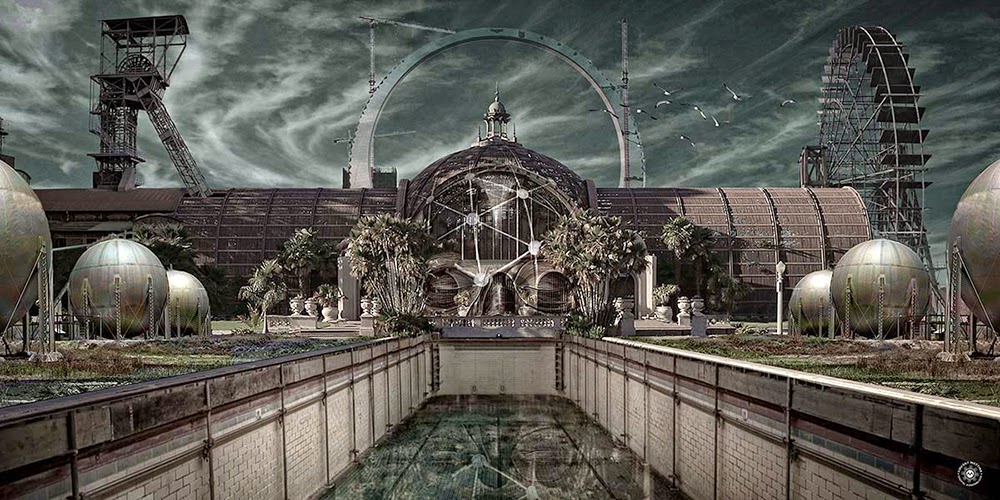
Vincent Mattina has selected one of the most photographer locations in Balboa Park - the reflecting pool in front of the arboretum. Mattina's surrealism follows the grand tradition of Salvador Dali in bending reality, but with the toolsets common to digital media - whether photographic, painting or other techniques. 

Vincent Mattina / Arboretum Hours
"My images convey a post-apocalyptic setting within Balboa Park perhaps 100 years from now. Although the images may appear as a melancholy epitaph to our current view, the viewer may see a ray of hope at the end of mankind's weary journey."

An alternative approach to surrealism and sci-fi is the hyper real technique that can fool the eye. Collaging a faux reality can present a problem for the unwary, but used in a transparent way such faux realities can provoke laughter and wonder. This image represents a park reality that could be true given the fascination with green technology, energy saving programs and a dubious water supply.
Joe Nalven / Sustainable Plaza
"If sustainability was really implemented at the Park, the aesthetic view would yield to views of functional energy and water technology. Perhaps, too, there is a hidden sign telling the public that the potable water they drink has been recycled."


San Diego Keeps Her Promise: Balboa Park at 100

Curated by Ginger Shulick Porcella and Francis French 

January 23 through February 22, 2015

San Diego Art Institute
1439 El Prado, Balboa Park
San Diego, California 92101

Hours:
Tuesday - Saturday
10am to 4pm
Sunday 12 noon to 4pm
Closed Mondays and major holidays

Tel: 619-236-0011


And then there was the nudist colony . . . 

San Diego is no stranger to outdoor bathing au naturel. Its Black's Beach has had an up and down history with acceptance by local (now prohibited) and state authorities (allowed). Trip Advisor still carries a page about the success of clothing optional swimming. 

The challenge for an artist focusing on public nudity is how to capture this mindset - something more than what is available on the internet, the movies and cable TV. 

The 1935 - 1936 Pacific International Exposition in Balboa Park featured a nudist colony (actually hired performers) in what is now the Zoro Butterfly Garden. The outdoor attraction was the best money maker and was billed as a place to see "[h]ealthy young men and women, indulging in the freedom of outdoor living in which they so devoutly believe, [and] opened their colony to the friendly, curious gaze of the public." [From David Marshall's San Diego's Balboa Park. See also David Marshall and Iris Engstrand, Pictorial Essay.] 

Saulo Cisneros's video installation combines the place (Zoro Garden Nudist Colony) with the photographic approach of Eadweard Muybridge: "I am not trying to recreate reality. What I am doing is to create moving scenes with series of still images. It is a homage to both Muybridge and to the nudist colony."

Saul Cisneros / The Zoro Garden Nudist Colony reimagined through Muybridge / Muybridge image (L); installed video at the rear (R)
"The video installation is called The Zoro Garden Nudist Colony reimagined through Muybridge. It is a video composed of animated photographies of the Eadweard Muybridge motion studies that reimagines (at this time and space) how individuals would have been hanging around at the nudist colony. The video is projected onto three layered translucid banners that measure 5' x 10' giving the video a three dimensional, but also a ghostly, texture. You can appreciate the piece from any side (so the projector shines onto you). You can see the projection with a visual overlapping of the SDAI crowd (which are the people that frequent Balboa Park at the present)."

And a reminder of gunboat diplomacy .  .  . 

Carlos Castro Arias’ presentation is a story about the U.S. and President Theodore Roosevelt’s taking over the French attempt to construct the Panama Canal. The French effort collapsed due to engineering difficulties and the high mortality due to malaria and yellow fever. The building of the canal was first proposed in 1534 by Charles V with the Spanish considering an easy way to voyage between the Atlantic and Pacific Oceans. Scotland attempted an overland route in 1698. The Panama Railway opened in 1855. The U.S. negotiated a treaty with Colombia in 1903 to take over the canal project but the Colombian Senate failed to ratify it. The U.S. then threw its support to Panamanian rebels and the U.S. benefitted from the formation of a new country. This was an example of U.S. gunboat diplomacy at that time.  It should be noted that a large part of South America that had been known as Gran Colombia (Venezuela, Colombia, Panama, Ecuador and parts of other countries) could have been a major counterpoint to the United States, but it fell apart in 1831. The question lingers why South America failed to have the success that the United States had with an equal amount of natural resources. 

Arias’ artwork and story emphasizes the U.S.’s dominant influence in the region, but the reasons for the failure of Latin America to achieve a similar success go back to earlier than U.S. dominance for the difficulties of Latin American regional integration. Also of note, the Nicaragua Canal – a route considered by the U.S. and others – was approved in 2013 in collaboration with Hong Kong. However, questions continue whether the financing is secure. 

Carlos Castro Arias / Other Stories
1915’s Panama - California Exposition commemorates the construction of the Panama Canal at the same time that Balboa Park was founded. At the same time, the Exposition is a memorial of a theft. Panama was part of Colombia until in 1903 when it was proclaimed independent after the intervention of the United States so they could build and own Panama’s canal for 85 years. Through the use appropriation of historical images, re-contextualization of objects and humor, the project Other Stories is conceived as an investigation and a creative inquiry about human condition in the Americas.

Each artist has crafted a distinct imagined park - as would be expected. But taken together, the exhibit offers a concept within a memory of what was and what could be.


Participating artists:  Carlos Castro Arias, Cat Chiu Phillips, Saulo Cisneros, Kate Clark & Hermione Spriggs, Francisco Eme, Ruben Franco Notch, Dave Ghilarducci, Will Given, Brian Goeltzenleuchter & Charmaine Banach, Jasna Gopic, Beliz Iristay, Vincent Mattina, Kathleen Kane-Murrell, Diego Leon, Chuck McPherson, Joe Nalven, Denise Strahm,  Paul Turounet, Scott Polach, Bianca Romani, Suzanne Thorpe, and Alex Young.


Notes:
I was intrigued by Francisco Eme's reference to the song, Amor de mis amores. There are a number of YouTube covers, but my favorite is one by Melissa Robles. 
Joe Nalven is a Board member of the San Diego Art Institute.
A thank you to Will Givens for information about the present of photography at the Fine Arts Building (1915 Exposition). 


Friday, January 2, 2015

Celebrating the Balboa Park Centennial – The California Tower reopens after 80 years

One of the most famous San Diego buildings is the California Tower. You’ve likely seen it at a distance or up close as part of the Museum of Man. Now it is open to the public after an 80 year hiatus.  The opening coincides with the beginning of Balboa Park’s centennial year celebration.

Two views of the Museum of Man – in front of the building and walking across the bridge
The storyabout the California Building and its tower is a fascinating one, but for many of us it is time to enjoy the views from the newly opened viewing area. Even a cloudy day provides the tourist, the seasoned transplant and the native San Diegan something that hasn’t been part of San Diego scene.

View from the bridge – looking east from the California Tower
Those climbing the tower might choose to use a smartphone, a film or digital camera, or even a special purpose camera such as a digital infrared DSLR. The opportunities to enjoy and remember the moment are bountiful.

Crowding into the entry to buy a ticket for the Museum of Man
I might add that I grew up in Brooklyn and visited the Statue of Liberty. That is still a gorgeous memory. The climb was strenuous and the crowds intense. But now I’ve acclimated to San Diego. The more laid back San Diego style is a different sort of cultural play. The California Tower is key to the San Diego style.

So, go up the tower and enjoy the view as you’ve never seen it before. Instead of looking up to the tiled dome, you’ll be looking down.  Photographers will delight in capturing that image and altering it in unimagined ways. Stay tuned for photo competitions.

Looking down on the Tower’s dome – a view from the camera and a fisheye reimagined view

The views inside the Tower provide added opportunities for the imagination. One might consider using the tour to propose marriage or serve as a backdrop for engagement photos. There are also interior architectural perspectives for interior design magazines or the art gallery. I can also imagine an annual major dance attraction in San Diego - Trolley Dances - using the tower as a venue. 

After climbing the traditional set of stairs, there is a circular stairway to the viewing area
If you’re reading this article, and if you’ve been to Balboa Park, AND if you’re in a playful state of mind, then go visit the California Tower. Go celebrate Balboa Park’s centennial. And take a friend or family member with you.


Tickets for the Tower tour are available for purchase online

Originally published at Times of San Diego