Showing posts with label digital art. Show all posts

Monday, July 31, 2017

Adding texture to 2D images: A fused glass overstrate approach

Taking a photograph is easy - unless, of course, you haven't taken a photograph before or cameras haven't been invented. Other difficulties that could be encountered in learning a new craft are assumptions about what words mean though they have a different sensibility as well novel aspects of that require some direct contact.  (See an example of traditional Japanese artistry using video.)

Perhaps, even more basic to a new technique and materials is the ever present question: "So what?" or "Why bother? I'm happy with flat 2D art."

My comments are not intended to persuade anyone to follow the approach sketched out below but to provide a description of this adventure in art along with several images (albeit handicapped by presentation on a 2D monitor).

I first tried working in glass at a workshop at San Diego City College that was offered as part of an exhibit by the Digital Art Guild in 2016.

Example 1:  Transfer image 

Joe Nalven, Meditation in Glass
This approach allowed the artist to print the image to transfer paper which, when soaked in water, was slipped off the paper substrate and onto the glass. One could paint on the the glass or add some glass elements to it. We were asked to pick a separate piece of glass that would later go over the first layer (to encapsulate the image). 

The result was intriguing - combining a soft and delicate sepia image with a variety of specialty paints and glass pieces. The bubbles might not have been attractive to those identifying themselves as 'glass artists,' but to someone who wanted to add texture to what was ordinarily a 2D flat image, the bubbles that were frozen in glass added dimensionality.

What I didn't realize was that when the glass was fired in the kiln, the base image was fired onto the bottom layer of glass allowing all but the iron oxide and carbon elements to remain - otherwise those gasses would form a giant black mass (carbon residue that did not burn off) in the encapsulated fused glass object.

I didn't realize the black mass  result when I went to a private glass art venue.* And we had several disappointing failures. Eventually, we solved this problem.

While working out the problem, I decided to try a different approach.
What if I just created a fused glass object that would lie over the printed image - in effect, an 'overstrate.'**


In either case, whether using a substrate or an overstrate, I was able to create the illusive one-of-a-kind that painters and sculptors claimed for themselves. Prints, whether photographic, digital composition, woodcut and the like, were always multiples (unless the artist simply printed one image and destroyed the matrix image used to make many copies or many 'originals'). 

By mixing media, joining a different substrate or overstrate, each image becomes an original - and not a multiple.

This may not be a concern for 2D flat artists who see themselves as working within that geometry. But, I was bedeviled by that frame of reference and wanted to work with both the 2D flat geometry as well as a 3D textured one.


So, where did my adventure with a fused glass overstrate take me?
Example 2a: Fused glass overstrate with image printed on the reverse side of the glass

       Joe Nalven, Icon (edited photograph) (Left)                               Joe Nalven, Icon (added fused glass elements presented in a light box) (Right)

The left hand image above shows an integration of two separates images. The idea was to recreate the icon used in Early Christianity dating back to the 3rd Century CE. 

The left hand image was placed below the bottom piece of glass to serve as a reference to where the red fritz in the halo would go as well as for locating the blue black dots inside the halo.  A second piece of glass was placed over the bottom glass (encapsulated) and then fired at about 1400 degrees in a kiln. 

When the encapsulated glass object came out of the kiln, I took the image to a print shop that specialized in prints for artists.***  I had the image of the icon printed on the back side of the glass overstrate.  Unless one actually looked on the reverse side of the glass, one might think the image was fused into the glass when it went into the kiln. However, digital inks would have burned off. 

Example 2b:

Joe Nalven, Eden (edited 2D photographic image) (Left)            Joe Nalven, Eden (glass overstrate with image printed on back of glass) (Right)
The second example shows a different placement of glass oddments (fritz, broken glass pieces) over the reference image. The embellishment of the glass rests with the artist's intuition about placement and type of additions - if one's objective is to retain artistic integrity and the one-of-a-kindness. 

One could ask, "Well, is the fused glass embellishment integrated with the 2D flat image any 'better' than simply presenting the 2D flat image?" 

Yes and no.  First, there is the question of artist's and viewer's preference - image on paper, on metal, with a plexiglass overlay?  The fused glass overstrate adds a mixed media element that may or may not accentuate the original image.  Second, it is possible to print the image on duratran, which is a semi-opaque surface. One could simply put this substrate with image into a light box and obtain a remarkable result as well (different from the image on paper with no illumination and different from an illuminated image with a fused glass enhancement). Yet another variation.****

If one looks at my own art, the variation in style and technique is evident. The adventure continues .  .  .


*   Joe's Glass Shack, 2426 Auto Park Way, Escondido, CA 92029

** Previously, I created texture by distressing a sheet of aluminum by brushing it and by adding patinas that would add color and corrode the metal. I created a ground or a substrate upon which I could laminate an image printed on mylar. Here, I inverted the process as it were:  I created a textured object that would float above the image (an 'overstrate') instead of having the object (the distressed aluminum) underneath the image (a 'substrate).

*** Pixel 2 Editions, 9520 Padgett St #103, San Diego, CA 92126

**** Kaz Maslanka creates mathematical poetic imagery printed on duratran and set into a light box. I was attracted to Maslanka's image presentation and was guided by his advice on the choice of light box. 


Tuesday, April 21, 2015

100 Artists, 100 Years: Celebrating San Diego Art at OMA

The Oceanside Museum of Art is exhibiting works from artists who belong(ed) to The San Diego Museum of Art Artists Guild. The time span is 100 years and 100 artists have been honored.

One of those artists, Mark-Elliott Lugo, selected the works included in this exhibit, drawing on his extensive experience in curating art exhibits in San Diego as well as being an artist and an art writer. 

Lugo admits to have a fascination with the dark - whether as darkness in color/luminance or in thematic content. That edgy quality is evident in his selection of Holly Weston's (below). 

Mark-Elliott Lugo noted that "This is the largest exhibition ever staged by OMA and as far as we know the largest featuring San Diego-area artists."

Joe Nalven:  I've been involved in many exhibitions, but not nearly as many as you have. Was there anything special about this one?

Mark-Elliott Lugo:  Putting this exhibition together in such a short amount of time (roughly three months) took everything I had in terms of physical stamina, knowledge about art and the art community, organizational skills, connections, installation experience, and judgment ("eye") as an artist." 

Daniel Foster, Director at OMA, noted that this exhibit builds on recent exhibits focusing on San Diego artists. Looking to the future, Robert L. Pincus will be jurying Artist Alliance at the Museum, 2015, July 11 - October 25, from submissions by OMA's member affiliate group Artist Alliance.

Pincus will also be co-curating History as it Happened: San Diego Art Seen Through the Critical Writings of Robert L. Pincus, Novemvber 21, 2015 - Mid April, 2016, with Tara Centybear and Executive Director Daniel Foster.


Mark-Elliott Lugo / Working on the exhibit presentation (Upper) / Displayed art include: 
Rhoda LeBlanc Lopez / Large Tree-Sized Planter, c.1960, Stoneware ceramic, 24 x 20 in., Collection of Gerald L. Thiebolt
Jackson Woolley, Bonus / 1967, Polyester resin and paint on wood, 19 ½ x 40 x 4 in., Collection of Courtney Cutter and Marc Sagal
Erik Gronborg / VØLUND, 1962, Bandsaw-carved wood timbers and black paint, 40 x 33 in

Portrait of the artist (Lower)
Holly Weston / Solace, 1998
I wondered how this project evolved and continues to evolve. I asked Angelika Villagrana and Jody Abssy, two of the coordinators of this project, about this exhibit and the book (forthcoming).

Angelika Villagrana:  When we started this project about 5 years ago, our objective was to publish a book celebrating 100 important Guild artists since its inception in 1915.  It took us a long time discovering and going through all the membership rosters and judging artists against a set of criteria for inclusion in this book.  Last Fall, Daniel Foster approached us with the idea of having an exhibition at the Oceanside Museum of Art for the 100 Artists whom we had identified.  All of a sudden there was very little time to meet with artists, families of deceased artists, collectors, galleries, institutions, etc. to get them to loan us the work. We had to put the book project on the back burner.  Now that the OMA exhibition is up, we will start working on the book project again and hope to get it published by the Fall.

Jody Abssy: There are 100 artists in the exhibition with about 125 objects on display. The number of architects who were Guild members surprised us. All 10 will appear on a video/ loop/ power point. When some of the pioneer artists' work was not available we were able to include some more contemporary artists. Our original intent was to publish a book which would bring the Guild's past into sharper focus for the public now and in the future.


Richard Becker / The Tot (Follow Your Dreams: Hanging Heart Spot Companion) 
Casts: 1 of 8 and Artist Proof 3, 2015, Stainless steel, 32 x 11 x 11 in.


  Oceanside Museum of Art
  704 Pier View Way, Oceanside, CA 92054
  www.oma-online.org

  100 Artists, 100 Years Exhibition: 1915-2015
  April 18 - July 26, 2015

  Opening Reception: 
  Saturday, April 25, 2015, from 6:00- 8:00pm

  Curator's Walk: 
  Wednesday, May 27, 2015

  Complimentary for OMA members, $10 for nonmembers

  Contact:  Raziah Roushan for exhibit information
                    raziah@oma-online.org


Pasha Turley / Inside-Out from The Pollution Series, intaglio (c. 1975), 32 x 40 inches (Left); 
Renata Spiazzi / Relationship, 16 x 7 ¾ x 3 ½ in., Memorial, 9 ¾ x 12 ½ x 5 ½ in., and Family, 13 x 7 x 7 in.,
all from the “Perfect Union Series," 1970, Polyurethane foam (Right)

Joe Nyiri, Bridges of Chicago No. 2, 1975, Aluminum, copper, and bronze 48 x 75 1/2 x 28 in.,
and Bridges of Chicago No. 1, 1974, Aluminum, copper, and bronze, 55 1/2 x 39 x 39 in.

William Gambini, Peg, 2002, Wood, canvas, and paint, 16 x 21 in. (Left) 
William Gambini, Untitled, 1999, Wood and paint, 50 x 8 ¾ x 8 ¾ in. (Right) 
 Both from the collection of Mark-Elliott Lugo
The 100 Artists

Martha Alf, Eleanor Antin, Anni Baldaugh, John Baldessari, Russell Baldwin, Belle Baranceanu, Richard Becker, Harry Bertoia, Carroll Parrott Blue, Leon Durand Bonnet, Rex Brandt, Maurice Braun, Capt. James Brown, Manuelita Brown, Charles Cristadoro, Joyce Cutler-Shaw, Dan Dickey, Phil Dike, John Dirks, Manny Farber, Arline Fisch, Jane Fletcher, Lorenzo Foncerrada, Russell Forester, Faiya Fredman, Charles Fries, William Gambini, Henry Lord Gay, Ken Goldman, Ethel Greene, Harold Gregor, Erik Gronborg, Thomas Grondona, Ruth Hayward, Fred Holle, Donal Hord, James Hubbell, Marjorie Hyde, Everett Gee Jackson, Frank Jones, Kwan Yee Jung, Bill Kelly, Dong Kingman, Sheldon Kirby, Alice Klauber, Doug Knutsen, Emil Kosa, Jr., Arthur Lavine, Leslie Lee, Beatrice Levy, Monty Lewis, Paul Lingren, Martha Longenecker, Rhoda Lopez, Mark-Elliott Lugo, Kathleen Marshall, Cliff McReynolds, Ivan Messenger, Alfred Mitchell, Hiroshi Miyazaki, Richard Allen Morris, Joe Nyiri, Christine Oatman, Robert Perine, James Tank Porter, Wilhelmina Pulsifer, Rob Wellington Quigley, Svetozar Radakovich, Barney Reid, Charles Reiffel, Richard Requa, Gail Roberts, Margaret Rocle, John Rogers, Ilse Ruocco, Lloyd Ruocco, Lyne T. “Bud” Shackelford, Lenore Simon, Robert W. Snyder, Renata Spiazzi, Harry Sternberg, Jean Swiggett, Mario Torero, Elliot Torrey, Sherman Trease, Raúl Trejo, G. Pasha Turley, Herbert B. Turner, Albert R. Valentien, Anna Valentien, Holly Weston, Michael Wheelden, Eileen Whitaker, Frederic Whitaker, Kay Whitcomb, Olaf Wieghorst, Guy Williams, Walter Haase Wojtyla, Ellamarie Woolley, Jackson Woolley


Postscript: The 101st Artist/Commentary on art in digital media - a personal perspective
While the 100 Artists from SDMAAG have been selected, and while a rewarding exhibition has been installed, I would like to add a flight of fancy about what might be included at some point. This postscript is not intended to argue with the selection of this exhibit, but to point the way to including the revolution in technology infusing almost every point of our lives -- from transportation, to communication, to health, to agriculture and industry and, yes, even to art. Several of the artists in SDMAAG have done well in making the 100 year history of the organization meaningful in the 21st century.

Notably, there are two artists who have drawn on new digital technology in this exhibit:  Guy Williams' untitled piece from the "Blueprint" series (1991) and Faiya Fredman's piece "Yellow Tulip 2" (2007) which was created when the artist was in her mid-eighties.

Perhaps it is possible to further expand on this connection to the digital revolution - after all, artists frequently love to consume the new. Here are some further examples in this vein.

Dennis Paul Batt, one-time Trustee of the San Diego Museum of Art and one-time President of SDMAAG, instituted a democratic selection of Best in Show. 

Greg Klamt, a digital artist - or a fantasy artist working in digital media, had his work, An Instant Past, voted in this new process as Best in Show (2002, SDMAAG Juried Exhibition). Klamt's music is an excellent companion to his fantasy imagery. 

Although Renata Spiazzi, selected as one of the 100 Artists/100 Years exhibit, is a self-described digital artist, her work selected is a part of her long trajectory in the arts - in this case, sculptural work rather than the fractal imagery she has been working in for the past two decades.

Both Klamt and Spiazzi were featured in separate chapters in Going Digital: The Practice and Vision of Digital Art (2005, Thompson, now Cengage Press). 

Digital art (or contemporary art in digital media) may be considered 'just a toolset' that encompasses photography, print, painting, and now sculpture (3D printing). All of these digital media can be conceived and implemented in non-digital media; however, fractals -- while appearing as painting or print -- is a mathematical algorithm that is exploited in often fantastical imagery. The practice is generally at a computer placing oneself at a distance from the actual object being created. The ability to work rapidly with the ability to undo previous steps resembles a miracle to those working in non-digital media. The collage/montage sensibility is quite natural in a layered and blended digital file. I expect that the last sentence is totally meaningless to those unfamiliar with digital media - which is like explaining sight to the  unsighted. So, 'just a toolset' is a very imperfect description of what art is in digital media - except when it is reduced in activities such as airbrushing photographs for commercial advertising.

As SDMAAG continues exhibiting, hopefully the members who are practicing in digital media are more fully incorporated with equal delight with their digital work as the 100 Artists in this exhibit.

Thursday, January 22, 2015

Balboa Park Centennial: Art in 1915, Art in 2015

In the year of Balboa Park’s Centennial, the many museums and activity centers located there are finding ways to reflect on the park’s past and wonder about its future.

A Point of Departure: Visual Fine Art - Then and Now

I’d like to suggest a comparison for its immediacy. Consider Will Given’s 2015 photograph, Echoes, with the prize winning painting by William Wendt,
 Mountain Infinity, at the Panama–California Exposition in 1915.

In 1915, photography was made for more for picture postcards and the daily papers - even with the exhibition including a separate section for fine art photography in the Fine Arts Building
.  

Over the past century, photography has become an important medium in the visual fine arts and has experienced major technological transformations, particularly digital capture and digital editing. Given’s photograph, Echoes, embodies high resolution digital photography (mirrorless full frame Sony a7r digital camera that produces a 36.4 megapixel image with multiple images composited in studio
); Givens also picks a modern theme of time and memory, with an after image creating a metaphor of the mind’s stuttering attempt to locate the object in time. Think of the movie Inception!


Will Given, Echoes
"The goal for Echoes is to show how through Balboa’s 100-year history. It is the constant that unites us all, even across temporal space. It is the place that allows us to feel a connection to our past, and to envision our own future when we are able to share the experience of the park with generations yet to come. It is a place where memory and nostalgia blend with the active engagement of progress. It is a place where we can look to the future in excitement over what the next 100 years will bring."
William Wendt’s painting, Mountain Infinity, captures a different California mood – of landscape, the outdoors and a spiritual connection found more in nature than the urban metropolis. 

Although Anthony Anderson's description in the Los Angeles Times (1911) is of Wendt's painting Topanga, one could easily apply it to Mountain Infinity. "[It is] with the perfect understanding that comes from perfect love. In his pictures of this wonderful canyon the very spirit of the out-of-doors and also -- what is equally to the point -- the very soul of Southern California, is felt." [Cited in William Wendt: Plein Air Painter of California by Will South]


William Wendt / Mountain Infinity, Grand Prize Winner at California Exposition, 1915 (L);
W.E. Averett / Picture Postcard, Aerial Photo of Panama-California Exposition, 1915 (R)

Curating a Contemporary Mindset: The San Diego Art Institute's Exhibit - San Diego Keeps Her Promise: Balboa Park at 100

The San Diego Art Institute (SDAI) houses multiple exhibits of contemporary art thoughout the year. Located in the House of Charm that was originally the Indian Arts Building, SDAI captures the many-faceted ways in which artists compose the world. This exhibit - San Diego Keeps Her Promise - is no different:  Balboa Park is visualized, textured, heard and sensed with the fragrances of the area.  

I've taken a sample of the artwork to illustrate how Balboa Park has been imagined in these various ways. Needless to add, go and see the exhibit to enjoy the full range of this past, present and imagined perspectives of Balboa Park.

A Sentiment Worth Sharing

Kathleen Kane-Murrell's Crossing Bridge evokes the sentiment that one enjoys in visiting Balboa Park. Kane-Murrell sees her images of this place capturing what William Wendt capured in his work some 100 years ago. "Someone recently said to me there is a spiritual nature to this place."

Not quite the landscape of Julian or the Anza-Borrego Desert, but an urban retreat. Presumably that's what a good park conveys. 

Kathleen Kane-Murrell / Crossing Bridge
"For 'Crossing Cabrillo in 2015' I used the materials common to me as an art teacher for children- crayon, paper, pencil, collage and acrylic paint. I embedded images and words from the Union Tribune’s last publication of 2014. I was struck by many things but in particular the lack of women listed as noteworthy in the last year.  One hundred years ago in San Diego women marched with banners that said, “I am a Person.” In 2015 women still ask to be recognized for who they are and what they contribute.  I can’t help but imagine how this landscape might change in the next hundred years." 

Textured Perspectives - More than Sight: Sound, Smell, Stitching and a Walkabout

How do we explore Balboa Park with all five senses? Many of us favor the Prado Restaurant for taste - and why not! But what about those other senses? How do we build those into a fine art perspective?

Brian Goeltzenleuchter and Charmaine Banach

One way to experience the Park is to do a walkabout with a map. Goeltzenleuchter and Banach printed 2000 maps of the Park that takes you on an interesting and unsual tour. The legend marks the following landmarks - each with its own story:
The Pheromone Story - Next to the Carousel
The Date Story - In Front of the Botanical Building
The Drug Story - North of Pepper Grove Playground
The Basketball Story - In the Municipal Gym
The Lily Pond Story - Near the Lily Pond
The Grandma Story - Between the Cactus Garden and the Rose Garden

Goeltzenleuchter summarizes this art work "as an art walk which uses locative media, olfactory art, digital audio and printed ephemera to take the participant on a narrative journey through Balboa Park."


Brian Goeltzenleuchter and Charmaine Banach / Balboa Stories / Park Map with Landmarks and Stories
San Diegans were asked if they had smell memories of Balboa Park - the sense of smell being a powerful memory trigger. The stories the San Diegans told were intimate, and often strange, slices of life: a perverse sports injury, a blissed-out drug trip, a romantic tryst gone awry. As opposed to taking a historical tone these stories are more like something you overhear at a bar - fish stories and shaggy dog stories. We preserved the stories’ spoken word form by digitally recording the narrative as told by the person who experienced it.

Cat Chiu Phillips

In days gone by, inspiring locations would be visualized on tapestries. Late Medieval and Renaissance churches and castles were home to decorative weavings that presented large figurative images. 

Cat Chiu Phillips work are not replicas of those historical tapestries, but one can sense the mix of textile and paper as echoing that sense of grandness and the importance of architectural figure. Her larger installations can be found at the San Diego Airport in Terminal 2. At SDAI, the smaller paper works are her artist proofs/sketche; the more intimate presentation should be equally compelling.


Cat Chiu Phillips / St. Francis Chapel / Mixed media with embroidery
"I have created works on paper focusing on the seven historical landmarks that have become permanent structures from the 1915 Panama Exposition.  This includes the Cabrillo Bridge, Botanical Building, Spreckels Pavilion, California State Building (now part of Museum of Man), Chapel of St. Francis, Fine Arts Building, and the California Bell Tower.  Each work is on paper and layered with archival images from the 1915 Exposition along with modern day informational handouts; each one is stitched together with architectural details from each respective structure. This juxtaposition invites the viewer to see each landmark's historical richness, cultural significance, and aesthetic timeless appeal." 

Franciso Eme 

Francisco Eme takes the Park as a series of milieux that influence us - in sight and sound. He composites his own impressions as a video and soundscape. 


Francisco Eme / Architectural Voice / Installation
The first time I visited Balboa Park I was surprised to see that its architecture had a lot of Mexican and Spanish influences. That same day I made an audio recording of  an American teenager musical trio that was playing a Mexican bolero called “Amor de mis amores”  outside the San Diego Museum of Art. The message was clear, Balboa Park is a multicultural place.  Along the day I kept recording audio finding a musical duo (Asian and Afroamerican musicians) playing “Cielito Lindo” a Mexican folk song on a steelpan, a musical instrument originated from Trinidad y Tobago.  Later the same day I went to the spot where you can see and hear airplanes so close because they are about to land, so they fly just above your head so I recorded that too. All on my very first day.

On my next visits to Balboa Park the impressions kept strengthening, finding musicians playing Didjeridoo, American folk, and a lot of different kinds of music from all around the world. So I kept recording. When listening to my recordings I found out that the soundscapes included phrases in many languages, the visitors of Balboa Park come from different countries too. Maybe because of California´s history  (that once was a Mexican territory) and San Diego´s condition in the present as a border city,  I think this mixture of cultures is natural. Later, when reading about Balboa Park´s history I discovered that its architecture was influenced by many Mexican colonial buildings and suddenly everything was clear to me. There is a reciprocity: the geography, the history and the people influenced Balboa Park´s architecture, and 100 years later the architecture influences the people and everything that happens in there. 

Architectural voice is a multimedia composition for 5.1 audio channels and 1 video. The video part contains images taken from the original Balboa´s 1914 architectural blueprints, while the  musical part is constructed from audio recordings of Balboa Park I have been doing  for some months, including a lot of different musicians and soundscapes. I call  Architectural Voice to those sounds that emerge from the human-architectural interaction. One hundred years after its creation, this is the Architectural Voice of Balboa Park. 

Connecting the Memory Dots

Over the past century plus, the most common way for us to connect our personal histories is with photographs. There was the Brownie Hawkeye and now cell phone cameras. Snap, snap, snap. Shoeboxes filled with family photos have given away to file folders on our computers. The photograph is the material side of holding on to our memories.

Paul Turounet also works with memory - cultural and personal. His approach is photographic, both contemporary and historical, and seeks the ‘normal’ in how Balboa Park was and is: “The photograph and picture postcard, front and back provides a narrative vignette to consider Balboa Park in relationship to our sense of memory and culture, collapsing our understanding of time and history from 1915 to 2015.”  

Indeed, a melancholy imagery. 

Paul Turounet / A Land That Makes Men Kind (excerpt) / an ongoing suite of vintage postcards from 1915 of the Panama - California Exposition and photographs from 2015 of Balboa Park

The Radical Departure: Digital Reflections 

Photography has had a bumpy road to acceptance as a fine art. Similarly, digital art - or contemporary art in digital media - has had a reluctant acceptance outside of digital cameras, FX movies and most of commercial photography. But what better way to conceptualize the future and alternative realities than with the playground of digital media. 

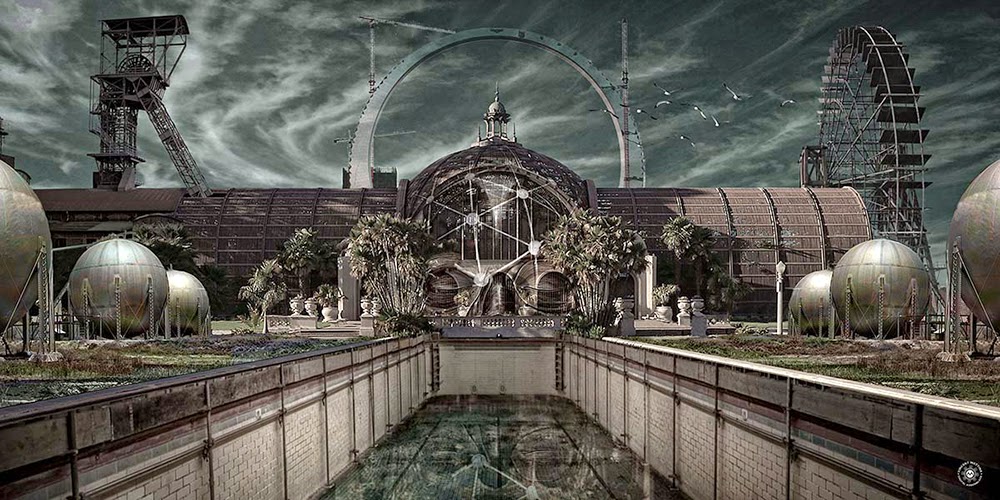
Vincent Mattina has selected one of the most photographer locations in Balboa Park - the reflecting pool in front of the arboretum. Mattina's surrealism follows the grand tradition of Salvador Dali in bending reality, but with the toolsets common to digital media - whether photographic, painting or other techniques. 

Vincent Mattina / Arboretum Hours
"My images convey a post-apocalyptic setting within Balboa Park perhaps 100 years from now. Although the images may appear as a melancholy epitaph to our current view, the viewer may see a ray of hope at the end of mankind's weary journey."

An alternative approach to surrealism and sci-fi is the hyper real technique that can fool the eye. Collaging a faux reality can present a problem for the unwary, but used in a transparent way such faux realities can provoke laughter and wonder. This image represents a park reality that could be true given the fascination with green technology, energy saving programs and a dubious water supply.
Joe Nalven / Sustainable Plaza
"If sustainability was really implemented at the Park, the aesthetic view would yield to views of functional energy and water technology. Perhaps, too, there is a hidden sign telling the public that the potable water they drink has been recycled."


San Diego Keeps Her Promise: Balboa Park at 100

Curated by Ginger Shulick Porcella and Francis French 

January 23 through February 22, 2015

San Diego Art Institute
1439 El Prado, Balboa Park
San Diego, California 92101

Hours:
Tuesday - Saturday
10am to 4pm
Sunday 12 noon to 4pm
Closed Mondays and major holidays

Tel: 619-236-0011


And then there was the nudist colony . . . 

San Diego is no stranger to outdoor bathing au naturel. Its Black's Beach has had an up and down history with acceptance by local (now prohibited) and state authorities (allowed). Trip Advisor still carries a page about the success of clothing optional swimming. 

The challenge for an artist focusing on public nudity is how to capture this mindset - something more than what is available on the internet, the movies and cable TV. 

The 1935 - 1936 Pacific International Exposition in Balboa Park featured a nudist colony (actually hired performers) in what is now the Zoro Butterfly Garden. The outdoor attraction was the best money maker and was billed as a place to see "[h]ealthy young men and women, indulging in the freedom of outdoor living in which they so devoutly believe, [and] opened their colony to the friendly, curious gaze of the public." [From David Marshall's San Diego's Balboa Park. See also David Marshall and Iris Engstrand, Pictorial Essay.] 

Saulo Cisneros's video installation combines the place (Zoro Garden Nudist Colony) with the photographic approach of Eadweard Muybridge: "I am not trying to recreate reality. What I am doing is to create moving scenes with series of still images. It is a homage to both Muybridge and to the nudist colony."

Saul Cisneros / The Zoro Garden Nudist Colony reimagined through Muybridge / Muybridge image (L); installed video at the rear (R)
"The video installation is called The Zoro Garden Nudist Colony reimagined through Muybridge. It is a video composed of animated photographies of the Eadweard Muybridge motion studies that reimagines (at this time and space) how individuals would have been hanging around at the nudist colony. The video is projected onto three layered translucid banners that measure 5' x 10' giving the video a three dimensional, but also a ghostly, texture. You can appreciate the piece from any side (so the projector shines onto you). You can see the projection with a visual overlapping of the SDAI crowd (which are the people that frequent Balboa Park at the present)."

And a reminder of gunboat diplomacy .  .  . 

Carlos Castro Arias’ presentation is a story about the U.S. and President Theodore Roosevelt’s taking over the French attempt to construct the Panama Canal. The French effort collapsed due to engineering difficulties and the high mortality due to malaria and yellow fever. The building of the canal was first proposed in 1534 by Charles V with the Spanish considering an easy way to voyage between the Atlantic and Pacific Oceans. Scotland attempted an overland route in 1698. The Panama Railway opened in 1855. The U.S. negotiated a treaty with Colombia in 1903 to take over the canal project but the Colombian Senate failed to ratify it. The U.S. then threw its support to Panamanian rebels and the U.S. benefitted from the formation of a new country. This was an example of U.S. gunboat diplomacy at that time.  It should be noted that a large part of South America that had been known as Gran Colombia (Venezuela, Colombia, Panama, Ecuador and parts of other countries) could have been a major counterpoint to the United States, but it fell apart in 1831. The question lingers why South America failed to have the success that the United States had with an equal amount of natural resources. 

Arias’ artwork and story emphasizes the U.S.’s dominant influence in the region, but the reasons for the failure of Latin America to achieve a similar success go back to earlier than U.S. dominance for the difficulties of Latin American regional integration. Also of note, the Nicaragua Canal – a route considered by the U.S. and others – was approved in 2013 in collaboration with Hong Kong. However, questions continue whether the financing is secure. 

Carlos Castro Arias / Other Stories
1915’s Panama - California Exposition commemorates the construction of the Panama Canal at the same time that Balboa Park was founded. At the same time, the Exposition is a memorial of a theft. Panama was part of Colombia until in 1903 when it was proclaimed independent after the intervention of the United States so they could build and own Panama’s canal for 85 years. Through the use appropriation of historical images, re-contextualization of objects and humor, the project Other Stories is conceived as an investigation and a creative inquiry about human condition in the Americas.

Each artist has crafted a distinct imagined park - as would be expected. But taken together, the exhibit offers a concept within a memory of what was and what could be.


Participating artists:  Carlos Castro Arias, Cat Chiu Phillips, Saulo Cisneros, Kate Clark & Hermione Spriggs, Francisco Eme, Ruben Franco Notch, Dave Ghilarducci, Will Given, Brian Goeltzenleuchter & Charmaine Banach, Jasna Gopic, Beliz Iristay, Vincent Mattina, Kathleen Kane-Murrell, Diego Leon, Chuck McPherson, Joe Nalven, Denise Strahm,  Paul Turounet, Scott Polach, Bianca Romani, Suzanne Thorpe, and Alex Young.


Notes:
I was intrigued by Francisco Eme's reference to the song, Amor de mis amores. There are a number of YouTube covers, but my favorite is one by Melissa Robles. 
Joe Nalven is a Board member of the San Diego Art Institute.
A thank you to Will Givens for information about the present of photography at the Fine Arts Building (1915 Exposition). 


Monday, January 12, 2015

Jean Isaacs’ Dances of Love, Laughter & Loss at UCSD Mandell Weiss Theatre

By Joe Nalven


A dance inspired by “The Atlantic Man.” 

What better way to restart the new year than to visit with Jean Isaacs Dance Theater. The performances are always delightful and create a sense of wonder in how she combines literary themes with modern dance.

The first of two dance sets is based on Marguerite Duras’ radio play, “The Atlantic Man.” It was first presented at the California Center for the Arts in Escondido in 2003 and now is being re-staged at the Mandell Weiss Theatre on the UC San Diego campus.


A reflective Jean Isaacs

Jean Isaacs’ choreography weaves the dance movements around the notions of love and loss. As she explained it:   
“The Atlantic Man’s central theme is how absence of a loved one is made more painful by knowing they were here and knowing that the moment will pass. “The Atlantic Man” metaphor is visualized as the birds he has seen at the beginning of the dance. Of course, taking the imagery and the play’s text and how it is choreographed as dance oversimplifies the performance and might even take away some of its magic. Much better to see the performance.”

One gets a sense of how this magic works by how the dance unfolds for one of the dancers. Erica Nordin danced in the first staging of the play in 2003:

“There is a lot of bird imagery used in Atlantic Man, and there are moments when we move as a flock onstage or channel a birdlike quality to get Jean’s direction across. We were given the idea of fullness versus emptiness. You can see this when one partner moves away from another and the one left behind somehow registers the emptiness energetically in their body. Personally, I look for a somewhat intense or intimate connection with my fellow dancers, to the beauty and tone of the music, and to the text of the piece. I allow it to be its own world and experience from start to finish each time.”


The second part of the program is “Pillow: Case.” The series of dance vignettes looks at love with cheeky mindfulness. You will laugh and you will smile. It is a world premiere using Meagan Marshall’s narrative. The key props in these dances are old pillow cases. They carry the memories of those who’ve slept on them.


From The “Pillow: Case” dance

Ariana Siegel provides the following insight: “The piece uses seemingly mundane objects — worn out relics, pillow cases — to meaningfully link people, experiences, and time. As a dancer, I open the linen closet door and blow dust off certain pillow cases. I slip down a nonlinear memory lane, meeting old ghosts, breathing life into them, and letting them dance together.”


From The “Pillow: Case” dance


From The “Pillow: Case” dance

Erica Nordin dances in the Pillow: Case as well: “Bringing about Jean’s ideas in some of the lighter pieces involves an aspect of physical comedy. I have to let go of any insecurities about looking the fool onstage. You really have to make where you’re coming from seem authentic to get the laugh across.”

Jean Isaacs is one of San Diego’s cultural treasures. Think about it. Go see the “Dances of Love, Laughter & Loss.”

· “Dances of Love, Laughter & Loss” at the Mandell Weiss Theatre at 2910 La Jolla Village Dr. on the UC San Diego campus

· Performances Friday and Saturday, Jan. 16-17, at at 8 p.m., and Sunday, Jan. 18, at 2 p.m.

· Tickets are available online at sddtlovelaughterloss.brownpapertickets.com

A group pose


This article was originally published in the Times of San Diego.