Showing posts with label Oceanside Museum of Art. Show all posts

Tuesday, April 21, 2015

100 Artists, 100 Years: Celebrating San Diego Art at OMA

The Oceanside Museum of Art is exhibiting works from artists who belong(ed) to The San Diego Museum of Art Artists Guild. The time span is 100 years and 100 artists have been honored.

One of those artists, Mark-Elliott Lugo, selected the works included in this exhibit, drawing on his extensive experience in curating art exhibits in San Diego as well as being an artist and an art writer. 

Lugo admits to have a fascination with the dark - whether as darkness in color/luminance or in thematic content. That edgy quality is evident in his selection of Holly Weston's (below). 

Mark-Elliott Lugo noted that "This is the largest exhibition ever staged by OMA and as far as we know the largest featuring San Diego-area artists."

Joe Nalven:  I've been involved in many exhibitions, but not nearly as many as you have. Was there anything special about this one?

Mark-Elliott Lugo:  Putting this exhibition together in such a short amount of time (roughly three months) took everything I had in terms of physical stamina, knowledge about art and the art community, organizational skills, connections, installation experience, and judgment ("eye") as an artist." 

Daniel Foster, Director at OMA, noted that this exhibit builds on recent exhibits focusing on San Diego artists. Looking to the future, Robert L. Pincus will be jurying Artist Alliance at the Museum, 2015, July 11 - October 25, from submissions by OMA's member affiliate group Artist Alliance.

Pincus will also be co-curating History as it Happened: San Diego Art Seen Through the Critical Writings of Robert L. Pincus, Novemvber 21, 2015 - Mid April, 2016, with Tara Centybear and Executive Director Daniel Foster.


Mark-Elliott Lugo / Working on the exhibit presentation (Upper) / Displayed art include: 
Rhoda LeBlanc Lopez / Large Tree-Sized Planter, c.1960, Stoneware ceramic, 24 x 20 in., Collection of Gerald L. Thiebolt
Jackson Woolley, Bonus / 1967, Polyester resin and paint on wood, 19 ½ x 40 x 4 in., Collection of Courtney Cutter and Marc Sagal
Erik Gronborg / VØLUND, 1962, Bandsaw-carved wood timbers and black paint, 40 x 33 in

Portrait of the artist (Lower)
Holly Weston / Solace, 1998
I wondered how this project evolved and continues to evolve. I asked Angelika Villagrana and Jody Abssy, two of the coordinators of this project, about this exhibit and the book (forthcoming).

Angelika Villagrana:  When we started this project about 5 years ago, our objective was to publish a book celebrating 100 important Guild artists since its inception in 1915.  It took us a long time discovering and going through all the membership rosters and judging artists against a set of criteria for inclusion in this book.  Last Fall, Daniel Foster approached us with the idea of having an exhibition at the Oceanside Museum of Art for the 100 Artists whom we had identified.  All of a sudden there was very little time to meet with artists, families of deceased artists, collectors, galleries, institutions, etc. to get them to loan us the work. We had to put the book project on the back burner.  Now that the OMA exhibition is up, we will start working on the book project again and hope to get it published by the Fall.

Jody Abssy: There are 100 artists in the exhibition with about 125 objects on display. The number of architects who were Guild members surprised us. All 10 will appear on a video/ loop/ power point. When some of the pioneer artists' work was not available we were able to include some more contemporary artists. Our original intent was to publish a book which would bring the Guild's past into sharper focus for the public now and in the future.


Richard Becker / The Tot (Follow Your Dreams: Hanging Heart Spot Companion) 
Casts: 1 of 8 and Artist Proof 3, 2015, Stainless steel, 32 x 11 x 11 in.


  Oceanside Museum of Art
  704 Pier View Way, Oceanside, CA 92054
  www.oma-online.org

  100 Artists, 100 Years Exhibition: 1915-2015
  April 18 - July 26, 2015

  Opening Reception: 
  Saturday, April 25, 2015, from 6:00- 8:00pm

  Curator's Walk: 
  Wednesday, May 27, 2015

  Complimentary for OMA members, $10 for nonmembers

  Contact:  Raziah Roushan for exhibit information
                    raziah@oma-online.org


Pasha Turley / Inside-Out from The Pollution Series, intaglio (c. 1975), 32 x 40 inches (Left); 
Renata Spiazzi / Relationship, 16 x 7 ¾ x 3 ½ in., Memorial, 9 ¾ x 12 ½ x 5 ½ in., and Family, 13 x 7 x 7 in.,
all from the “Perfect Union Series," 1970, Polyurethane foam (Right)

Joe Nyiri, Bridges of Chicago No. 2, 1975, Aluminum, copper, and bronze 48 x 75 1/2 x 28 in.,
and Bridges of Chicago No. 1, 1974, Aluminum, copper, and bronze, 55 1/2 x 39 x 39 in.

William Gambini, Peg, 2002, Wood, canvas, and paint, 16 x 21 in. (Left) 
William Gambini, Untitled, 1999, Wood and paint, 50 x 8 ¾ x 8 ¾ in. (Right) 
 Both from the collection of Mark-Elliott Lugo
The 100 Artists

Martha Alf, Eleanor Antin, Anni Baldaugh, John Baldessari, Russell Baldwin, Belle Baranceanu, Richard Becker, Harry Bertoia, Carroll Parrott Blue, Leon Durand Bonnet, Rex Brandt, Maurice Braun, Capt. James Brown, Manuelita Brown, Charles Cristadoro, Joyce Cutler-Shaw, Dan Dickey, Phil Dike, John Dirks, Manny Farber, Arline Fisch, Jane Fletcher, Lorenzo Foncerrada, Russell Forester, Faiya Fredman, Charles Fries, William Gambini, Henry Lord Gay, Ken Goldman, Ethel Greene, Harold Gregor, Erik Gronborg, Thomas Grondona, Ruth Hayward, Fred Holle, Donal Hord, James Hubbell, Marjorie Hyde, Everett Gee Jackson, Frank Jones, Kwan Yee Jung, Bill Kelly, Dong Kingman, Sheldon Kirby, Alice Klauber, Doug Knutsen, Emil Kosa, Jr., Arthur Lavine, Leslie Lee, Beatrice Levy, Monty Lewis, Paul Lingren, Martha Longenecker, Rhoda Lopez, Mark-Elliott Lugo, Kathleen Marshall, Cliff McReynolds, Ivan Messenger, Alfred Mitchell, Hiroshi Miyazaki, Richard Allen Morris, Joe Nyiri, Christine Oatman, Robert Perine, James Tank Porter, Wilhelmina Pulsifer, Rob Wellington Quigley, Svetozar Radakovich, Barney Reid, Charles Reiffel, Richard Requa, Gail Roberts, Margaret Rocle, John Rogers, Ilse Ruocco, Lloyd Ruocco, Lyne T. “Bud” Shackelford, Lenore Simon, Robert W. Snyder, Renata Spiazzi, Harry Sternberg, Jean Swiggett, Mario Torero, Elliot Torrey, Sherman Trease, Raúl Trejo, G. Pasha Turley, Herbert B. Turner, Albert R. Valentien, Anna Valentien, Holly Weston, Michael Wheelden, Eileen Whitaker, Frederic Whitaker, Kay Whitcomb, Olaf Wieghorst, Guy Williams, Walter Haase Wojtyla, Ellamarie Woolley, Jackson Woolley


Postscript: The 101st Artist/Commentary on art in digital media - a personal perspective
While the 100 Artists from SDMAAG have been selected, and while a rewarding exhibition has been installed, I would like to add a flight of fancy about what might be included at some point. This postscript is not intended to argue with the selection of this exhibit, but to point the way to including the revolution in technology infusing almost every point of our lives -- from transportation, to communication, to health, to agriculture and industry and, yes, even to art. Several of the artists in SDMAAG have done well in making the 100 year history of the organization meaningful in the 21st century.

Notably, there are two artists who have drawn on new digital technology in this exhibit:  Guy Williams' untitled piece from the "Blueprint" series (1991) and Faiya Fredman's piece "Yellow Tulip 2" (2007) which was created when the artist was in her mid-eighties.

Perhaps it is possible to further expand on this connection to the digital revolution - after all, artists frequently love to consume the new. Here are some further examples in this vein.

Dennis Paul Batt, one-time Trustee of the San Diego Museum of Art and one-time President of SDMAAG, instituted a democratic selection of Best in Show. 

Greg Klamt, a digital artist - or a fantasy artist working in digital media, had his work, An Instant Past, voted in this new process as Best in Show (2002, SDMAAG Juried Exhibition). Klamt's music is an excellent companion to his fantasy imagery. 

Although Renata Spiazzi, selected as one of the 100 Artists/100 Years exhibit, is a self-described digital artist, her work selected is a part of her long trajectory in the arts - in this case, sculptural work rather than the fractal imagery she has been working in for the past two decades.

Both Klamt and Spiazzi were featured in separate chapters in Going Digital: The Practice and Vision of Digital Art (2005, Thompson, now Cengage Press). 

Digital art (or contemporary art in digital media) may be considered 'just a toolset' that encompasses photography, print, painting, and now sculpture (3D printing). All of these digital media can be conceived and implemented in non-digital media; however, fractals -- while appearing as painting or print -- is a mathematical algorithm that is exploited in often fantastical imagery. The practice is generally at a computer placing oneself at a distance from the actual object being created. The ability to work rapidly with the ability to undo previous steps resembles a miracle to those working in non-digital media. The collage/montage sensibility is quite natural in a layered and blended digital file. I expect that the last sentence is totally meaningless to those unfamiliar with digital media - which is like explaining sight to the  unsighted. So, 'just a toolset' is a very imperfect description of what art is in digital media - except when it is reduced in activities such as airbrushing photographs for commercial advertising.

As SDMAAG continues exhibiting, hopefully the members who are practicing in digital media are more fully incorporated with equal delight with their digital work as the 100 Artists in this exhibit.

Sunday, March 15, 2015

Picturing a San Diego Dream: Exhibits at L Street Fine Art and the Oceanside Museum of Art

The danger of blissful dreams is that they invite others to dream those dreams as well.

And so, we have San Diego Dreaming at the L Street Fine Art  in downtown San Diego and a collaborative location at the Oceanside Museum of Art.

The artists in the San Diego Dreaming exhibits have compelling images that invoke what we believe is the magic of this community – from semi-arid desert lanscapes often disguised by the import of water; its cascading mountains of sandstone andsiltstone above the wondrous beaches; witnesses to the greenflash at sunset; native spirits in Vulcan Mountain; the mini flowers of the Anza-Borrego desert; and, of course, the Marine Corps Base at Camp Pendleton that separates us from Los Angeles and a suburbanizing coast.

As a point of reference, I came to San Diego from New York City for a two week stay. That was 45 years ago, trading in the place known as The Big Apple for the Southwestern-most-corner of the United States. 

Composing San Diego Dreams 

A persistent question:  Are the dreams of San Diego artists any different than those in London, Calcutta, Paris or New York? In many ways, the locale and its geography override the imagined mysteries of its residents; and, we would be quick to ask how different is San Diego from other Southern California surfing and beach communities or, as one moves inland, from other inland desert communities.

Several artists commentaries open the door for starting this conversation about how and what San Diego artists imagine (while allowing an open framework to connect with how and what artists dream elsewhere).

Ken Goldman (Totally Fried, below): 
Many places have fairs; each are unique to their own area. Here we get to see everything San Diego because it is a showcase for the best of so many local endeavors from art, to music, to flower growing, wood carving, rock hunting .  .   .  you name it. Even some of the fried food vendors are local.
I am not sure whether the idea of dropping off one's intellect at an entry gate to become a rube for a day is everyone’s idea of a dream day, but once a year, it's just so darn different and fun that its a dream-like day for me. Eating totally fried food that I would normally never touch, looking at livestock, chickens, rabbits, people watching and taking lots of photos of colorful people doing colorful things, especially during a warm side-lit golden California Sunset (as a basis for colorful paintings), just looking around, being away from the grind, is a California Dream. And then, at the end of the day, I always wonder where time went and leaving for home always seems a bit unreal. Yet each year we look forward to going back! 

Robert Pendleton (Window, below):
Window is an original digital image with colorized luminosity in the underexposed portion of the image.  It was taken from my bedroom window in a condo in Oceanside where I lived for a few years, and it represents the theme of San Diego Dreaming in several respects. I moved to La Jolla from Sacramento when I was 8-years old, which was just old enough for me to realize what an enchanted place I had come upon, and how fortunate I was to live only a few miles away from the beach.  I was immediately drawn to the beach, and learned to respect the ocean by nearly drowning on an occasion or two, but even so, I always cherished every trip there.  The beach was my playground; I used it to skim board, snorkel, boogey board, fish and eventually scuba dive.  I went there to watch the sunset, sit around a fire, play backgammon, and party, and my dream was to one day live in a house on the beach, drifting off to sleep each night with the sounds of the waves and the smell of the ocean air. Living on the beach is a broadly held dream, and in many ways, the defining element of the San Diego Dream. 

A few years ago I came close to realizing that dream when my ex-wife and I purchased a condo one-half block away from the beach in Oceanside.  Unfortunately I had to give the condo up when we divorced, so I spent the last few months there photographing every possible aspect of my view to the ocean, and the peculiar architecture of that building. Window was taken at sunset from my bedroom near the beach, and is a part of that series of images. Alteration of the diffracted light on the window’s edge to an unreal spectrum of color plays upon the notion of a dream as something man-made and artificial yet based on reality and possibilities.  The aspect ratio of Window and limitation of the ocean view to a narrow strip represents that narrow window (financial and practical) of my living within view of the beach, and the relative importance we place upon encasing ourselves in boxes of walls, that exclude even light, in our efforts to create a perfectly controlled synthetic environment in which to comfortably live.

Rosemary Valente (Earth, Wind and Fire, below):
Living in Carlsbad, my home has literally come close to being obliterated by fire several times. In the past 10 years there have been three threats of fire with strong winds looming within a mile of my home.  Last year in Carlsbad, I could see the fiery shapes and smell the intense fumes all too  close.  I aimed to convey this in Earth, Wind and Fire. This image portrays those horrific moments that could have brought tragedy to me and unfortunately did bring tragedy to many others. Firemen kept the fire away from our property and life goes on with our blue skies and warm waters in San Diego.

Mark Jesinoski (Emerging, below):
I moved to San Diego because I believed it was a place I could redefine myself.  My perspective of southern California, and San Diego specifically, was that it was a place where many peoples came together to form a unique culture, that was defined as much by its diversity as it was by its juxtaposition to the Pacific Ocean.  When I moved here I took a chance and completely redefined my work because I was not only inspired by the waters of the Pacific, but I had always since I was a boy in Minnesota reading Zoo Book magazine (I still have them all), been inspired by the idea of the waters of the Pacific; I perceived my relocation to San Diego to be my opportunity to define and express my identity as purely and simply as I could.  This came out artistically - because of this shift and because of the context of San Diego - in art that was inspired by water in both form and process. Water is my great metaphor for change. This is my San Diego dreaming story.  

Julianne B. Ricksecker (California Gold, below):
California Gold is an etching, a landscape view from the mountains -  driving on I-8 returning from the mountains in the late afternoon, with the golden sun illuminating San Diego Harbor, silhouetting the Point Loma land mass and Coronado and the Strand. For me, part of the San Diego dream is that I can enjoy the pleasures of nature at the beach, in the mountains, or on the desert - all within the space of a day!  Having grown up in Pittsburgh, where I dreamed about seeing the ocean someday, living in San Diego is a constant.  Of the three types of landscape, the only one I was personally exposed to as a child was mountains, and the vegetation on mountains in Pennsylvania, which are quite different from our Southern California mountains. And, I can choose to go visit snow, or not. I love the openness of the landscape and our strange and wonderful local native plants. As I am typing, just got a text from a friend that the desert is blooming, inquiring when can we head out that way?  Case in point! 


Robert Avon Lees (The Return, below):
Frank Lloyd Wright reportedly said, “All the loose marbles in the country rolled to the California Coast.” California is and has a history of migrating, expansive, open minded, searching, daring, spiritual, and beach loving individuals.

San Diego is inspiring to a dreaming visionary person. My art gravitates to the subject of science as well as to mystical and metaphysical insights. I see San Diego as a place to incubate and prosper and dream.  There is just something in the air that fosters this creative multi-disciplinary cross pollination.  The environment nurtures thoughts and visions.  My California dream painting is abstract with forms and colors as a metaphorical was of expressing different emotions, movements and qualities of life. 


The Return conveys particles moving in a unifying energy field.  The physical world, matter, unfolds out of and returns back into the deeper underlying source, spirit consciousness. 

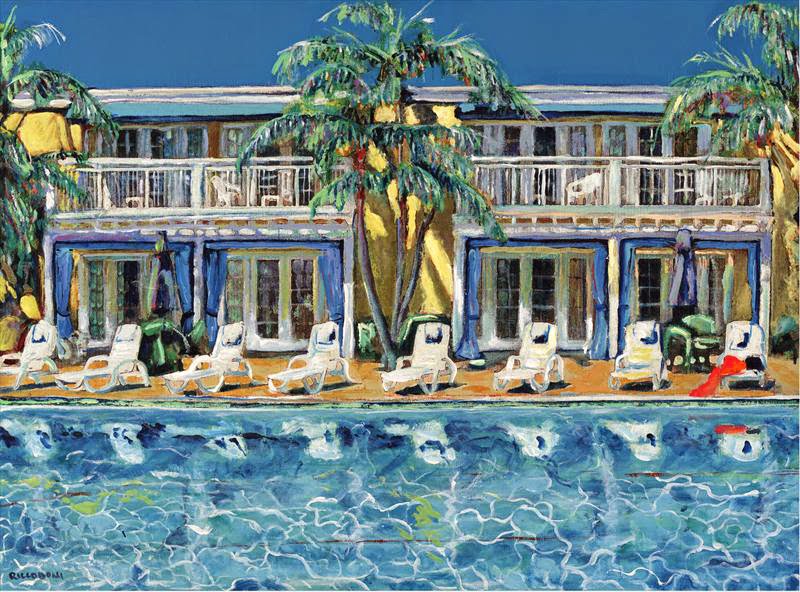
RD Riccoboni (Shimmering Poolside, below):
San Diego, in the big city sense, is a good example of capturing moments of the elusive dream of forward thinking: I pick up on the positive sense of place in vibrations of color, contrast, perspective and spirit that surround our daily lives in the historic places and landscape that I have come to love. 

A Sampling of Images at L Street Fine Art (of a total of 70 images at L Street Fine Art and the Oceanside Museum of Art)
  

Robert Avon Lees / The Return
Ken Goldman / Totally Fried

Amber George / Otay 1


Julianne B. Ricksecker / California Gold


RD Riccoboni / Shimmering Poolside at the Lafayette 

Rita Shulak / California the Beautiful

Robert Pendleton / Window

Julie Ann Stricklin / Pacific Patriot

     Margaret Larlham / Mission Dam

Shuang Li / Tideland Park

Rosemary Valente / Earth, Wind and Fire
The artists exhibiting at L Street Fine Art are:  Rebecca Bauer, Bre Custodio, Paula Des Gardins, Richard Dowdy, Amber Foote, Helen Garcia-Shafer, Amber George, Ken Goldman, Jim Hornung, Mark Jesinoski, Kirby Kendrick, Margaret Larlham, Robert Avon Lees, Anita Lewis, Shuang Li, Chris Martino, Glen Maxion, Connie McCoy, Joe Nalven, Diane O'Connell, Robyn Oliver, Rob Pendleton, Robin Raznick, RD Riccoboni, Jullianne Ricksecker, Rita Shulak, Julie Ann Stricklin, Michael Taylor, and Rosemary Valente.

What's your dream? Is it about San Diego? Join the conversation and explore the San Diego Dreaming exhibits.


628 L Street, San Diego, CA 92101
director@lstreetfineart.com
Daily:  9:00 a.m. to 4:00 p.m. daily and by appointment
Reception -- June 6, 2015  /  6 - 9pm
Exhibit dates: March 30- June 30, 2015


704 Pier View Way, Oceanside, CA 92054
(760)435-3720
Tuesday – Saturday:  10am - 4pm
Sunday:  1pm - 4pm

Exhibit dates:  February 28 - June 21, 2015

The artwork at L Street Fine Art was curated by Kay Colvin, while that at the Oceanside Museum of Art was curated by Malcolm Warner.

This article expands upon the article appearing in the Times of San Diego:   Local Artists Display their Varied Dreams of San Diego, March 10, 2015.

Joe Nalven's image, A Pueblo Tourist Visits the San Diego County Fair, is at L Street Fine Art. 


Tuesday, December 16, 2014

Omar Lopex: The Photography of Pretend Families

Families come in many configurations ─ polygynous, polyandrous, extended, nuclear, blended, and the like.

But pretend families? We can find them in Sesame Street, the 
Familyquins, faux family portraits, and more broadly in ethnographies of pretend family play.

The challenge for an artist who immerses him- or herself in a theme is convincing the viewer of its significance. There needs to be a power that grabs the viewer and makes that theme important in some way. Omar Lopex gets us thinking about family once more.

Lopex makes his pretend families seem real, in part, by using photography from the distant past with tintype photographs. Everything was more real way back then, wasn't it? No Hollywood, no hucksterism, and no Photoshop. Well, maybe that wasn't the way it really was, but the Lopex's tintypes create just enough doubt that his images draw us in. Maybe that was the way it really was.

Joe Nalven: What are pretend families?

Omar Lopex: For me, defining what a pretend family is, involves defining what it's not. It's not Fantasy. It’s important for me to distinguish between Fantasy and Pretend. Fantasy implies a desire a longing a wish it has a focus a distinct aim; Pretending is rooted in the act itself. The heart of this project lies in Pretend’s open-endedness – exploration without obligation or commitment. For me, Pretending does a loop and reinforces everything else that is Real.


Omar Lopex / Pretend Family #25
JN: Are pretend families interesting in ways that are different than 'real' families?

OL: The concept of a pretend family is interesting to me, but even more interesting were the people I actually worked with. For every shoot, I was meeting someone new, and working with them on creating this lie. So each person's personality, style, their home, the ideas they contributed to what the scene in our foto should be, that was interesting in a way that a normal real family isn't.

Omar Lopex / Pretend Family #17
JN:  Are you considering other pretend families? 

OL:  I've been thinking of how to continue the project, which would involve traveling farther and collaborating with people I have less and less in common with. The thing I'm keeping in mind is how not to do it in a trite way. I don't want to create any boring work. But it does feel like the theme isn't entirely tapped. If I do it again, I also might change mediums. It would still be something analog, and in a small format though. Right now I'm shooting a lot of direct paper prints with a brownie camera, and a smaller portable darkroom (fits in a suitcase).

Omar Lopex / Pretend Family #11
JN:  Have you thought about putting these families onto other media?

OL:  If I documented the pretend families in any other media, it would have to be in something that was still small and humble. Besides being in love with the small format, the project just wouldn't work in a large format. A big picture, in this project, would’ve ruined the believability of the image. A large format foto is often too stunning. It would focus too much attention on the image as an object itself instead of the intended story in it. To work the images have to be something, but just as important they have to be nothing – they have to be something you could throw away, or something that someone else threw away and that you found.


Omar Lopex / Pretend Family #6
JN:  What kind of feedback have you gotten?
OL:  The feedback had been pretty consistent. The two things I hear the most from people are that they think the idea of working with all these different people is beautiful, and that the fotos look realistic and that they almost don't even notice that it's me in some of them. For me that's fantastic, and its what I aimed for people to get out of the project. I can be sort of a bull or an ape, kind of loud in real life, and I love spectacle, but I also have a big thing for smallness and subtlety and vulnerability.

JN:  How do you go about making these images?
OL:  I started teaching myself wet plate fotography several years ago. The work in RELÁMPAGO was all done by me, all fotos developed on the spot, in the special portable darkroom I outfitted on my motorcycle.


November 8, 2014 - February 8, 2015

Omar Lopex: Relámpago

Relámpago is Spanish for “lightning,” referring to the moments of illumination captured directly on solid metal plates for this exhibition of Omar Lopex’s intimate tintype photographs. A photograph documents reality without context: what appears to be a wide variety of traditional family portraits exploring different representations of familial relationships, is in fact a complex game of pretend. Using a motorcycle specially outfitted with a darkroom to develop images on the spot, Lopex visited four different cities to meet strangers and become a part of their family for as long as it took to shoot and develop these images. The resulting small-scale artworks draw the viewer into a fictional world, challenging the traditional concepts of identity, personal space, and familial roles.

704 Pier View Way, Oceanside, CA 92054
(760)435-3720
Tuesday - Saturday; 10am - 4pm; Sunday 1pm - 4pm
Closed major holidays
General admission $8;  Seniors 65 + $5