Showing posts with label Joe Nalven. Show all posts

Sunday, March 15, 2015

Rethinking the Garden of Eden as a Dance Video: The Conversation between Eve and Lilith

As far back as we can trace our cultural memory, there has always been a question and a story. How did we get here? Why? A question and a story about the creation of man and woman. 

I was intrigued by this question and decided to reinvent the version played out, somewhat ambiguously, in Genesis. At first, I wrote a 5 minute play for a competition for short-, short plays. But, as a visual artist, I wanted to tell the story in video form and not my usual flat, 2D image that would be hung on the wall or seen at some internet site. 

Inspirational Points of Departure - The Dance and the Video
I was inspired by Jean Isaacs' Trolley Dances (onsite dances in and around the San Diego trolley stations) as well as dances at the White Box and UCSD Mandell Weiss Theater. I have multiple digital files on my computer that attest to my photographic fascination with these events. But photography is not quite videography.

Trolley Dances 2014 / City College / Ariana Siegel and Jedi Taylor
I had to acquire new capture, editing and presentation methodologies. Seeing movies is not the same as making a movie; making a home movie on a smartphone is not the same as organizing, filming and editing a movie for prime time. Some YouTube videos reach this point of perfection, most do not. Several of the Gotan Project videos reaffirmed my decision  to take this adventure:  La GloriaEpoca - Un Tango Sensual; Epoca - Igor StravinskyDiferente; and many others.

And, of course, there is Grace Jones' Corporate Cannibal.

The challenge was how to wed video and dance to the Garden of Eden - as an objet d'art, rather than a commercial song promo. While I enjoy watching song/dance videos like The Pussycat Dolls (with Timbaland) Wait a Minute, my mindset seeks a deeper engagement with the eternal love song.

Male/Female Creation Stories

The most familiar male/female creation story is likely the Garden of Eden. But, even here, there is a question of who the first woman was.

Genesis 27 reads as follows:
So God created man in his own image, in the image of God he created him;
male and female he created them.
There is no name for this first woman. An interpretation, or midrash, suggests that this woman was Lilith.

Only later, after God fashions woman from Adam's rib, and after eating the apple and falling from a protected status in Eden, do we have a name - Eve. (Genesis 3:20 - Adam named his wife Eve, because she would become the mother of all the living.) 

This dual story line of two different women being created in the Garden of Eden raises a question about why Lilith, the first wife of Adam, would leave. Why was she discontented with Adam and left of her own accord, and in subsequent rabbinic literature, becoming something of a succubus demon?

Other male/female creation stories abound. One of my favorites is the Blackfoot tale of Old Coyote Man Meets Coyote Woman, each separately existing in the other half of the world until they encountered each other by accident.

Eve Meets Lilith in the Garden of Eden (video link)

you can also cut and paste this URL to your browser to stream the video:
http://online2.sdccd.edu/faculty/jnalven/nalven_compressed/nalven_compressed_player.html

A What-If Scenario
Instead of the common interpretations of Adam/Eve, Eve/Snake, God/Adam/Eve, God/Serpent, gods (among themselves), what if we focused on the conversation of Eve and Lilith? What if these two women overlapped each other in time? 

Here, two women in the Garden of Eden might be compared to Beckett's Waiting for Godot. Two vibrant women at the beginning of humanity rather than two older men bored with their absurd existence.

In the short play that I wrote, I presented the Eve and Lilith conversation; but, as a video of a dance, the text could be constraining. That would depend on the choreographer's approach to translating a text narrative into a choreographed narrative, or words versus movement; semantics versus kinesics.

Also, I was about to enter a learning curve - about dance, about wedding dance to a piece of music, about videography, about editing and the like - and all at one time. 

The Evolution of Humanity - Language, Communication, Meaniing and Even Bodily Form and Function

When we look through the prism of archaeology, paleoanthropology, evolutionary genetics and like-minded sciences, the search is for actual connections and processes that tie modern man to ancient forbears. Those points in time are measured in the millions of years, although more recent benchmarks are appealing for homo sapiens sapiens, especially with respect to human language, advanced toolmaking and the beginnings of agriculture. 

But when was the Garden of Eden? As a metaphor for human evolution, the actual years are unimportant. Instead, we think about those human benchmarks - like sin - that resulted from being sent out of the Garden.

Then wilt thou not be loth
To leave this Paradise, but shalt possess A Paradise within thee, happier far ...They hand in hand with wandering steps and slow Through Eden took their solitary way.
John Milton, Paradise Lost

So, how would one construct a conversation between Eve and Lilith - part metaphor and part evolutionary growth in human communication? 

For this video dramatization, I imagined a non-verbal conversation - a conversation that existed before language triumphed over the physicality of relationship.  Dance and music are especially good to imagine such a conversation between the first women. Harkening to a Schopenhauerian perspective, it is music - music without words, perhaps with barks and howls - that reaches deep into our connecting to the force of nature, before with idealize our representations in words. 

That became the framework of instructions to the dancers. Now you meet; now you hear Adam somewhere about in the Garden; now recognizing the fecundity of womanhood; now recognizing the taking leave (by Lilith).  Cues that called out non-verbal interaction.

So, part of the solution to my learning curve in making a dance video was to create a conceptual framework for the dancers to structure their movement, filming the same sequence in different ways - and once with painted faces akin to the way in which the Omo tribes of Ethiopia decorate themselves. 

Editing Towards Perfection
One quickly appreciates that having the elements of a video (or any object composed of pieces) requires imaginative editing. Cutting and pasting is much more than simply cutting and pasting. Aristotle was acutely aware that the difference between a bunch of bricks and a house (with the same size and number of bricks) was form. That is what an architect brings to the realization of plain versus beautiful buildings. The same with building a dance video. 

With the assistance of David Giberson at Miramar Community College, I worked towards learning the elements of a video editing program and while concurrently building the video. With my long-term working with Photoshop, I looked for ways to make a compelling visual flow that synced to a musical sentiment. Since there was little opportunity to delve into special effects, I opted for montaging the several filmed sequences together, slightly offset in timing to create a multiple and asymmetrical communication between Eve and Lilith.

What does that mean? That means watch the video and test its coherence and persuasiveness as a video objet d'art.

For the future:  Watch for a quite different approach to the conversation between Eve and Lilith, with a dash of Adam.  To be performed in Balboa Park as part of its centennial celebration and choreographed by Jean Isaacs.

Picturing a San Diego Dream: Exhibits at L Street Fine Art and the Oceanside Museum of Art

The danger of blissful dreams is that they invite others to dream those dreams as well.

And so, we have San Diego Dreaming at the L Street Fine Art  in downtown San Diego and a collaborative location at the Oceanside Museum of Art.

The artists in the San Diego Dreaming exhibits have compelling images that invoke what we believe is the magic of this community – from semi-arid desert lanscapes often disguised by the import of water; its cascading mountains of sandstone andsiltstone above the wondrous beaches; witnesses to the greenflash at sunset; native spirits in Vulcan Mountain; the mini flowers of the Anza-Borrego desert; and, of course, the Marine Corps Base at Camp Pendleton that separates us from Los Angeles and a suburbanizing coast.

As a point of reference, I came to San Diego from New York City for a two week stay. That was 45 years ago, trading in the place known as The Big Apple for the Southwestern-most-corner of the United States. 

Composing San Diego Dreams 

A persistent question:  Are the dreams of San Diego artists any different than those in London, Calcutta, Paris or New York? In many ways, the locale and its geography override the imagined mysteries of its residents; and, we would be quick to ask how different is San Diego from other Southern California surfing and beach communities or, as one moves inland, from other inland desert communities.

Several artists commentaries open the door for starting this conversation about how and what San Diego artists imagine (while allowing an open framework to connect with how and what artists dream elsewhere).

Ken Goldman (Totally Fried, below): 
Many places have fairs; each are unique to their own area. Here we get to see everything San Diego because it is a showcase for the best of so many local endeavors from art, to music, to flower growing, wood carving, rock hunting .  .   .  you name it. Even some of the fried food vendors are local.
I am not sure whether the idea of dropping off one's intellect at an entry gate to become a rube for a day is everyone’s idea of a dream day, but once a year, it's just so darn different and fun that its a dream-like day for me. Eating totally fried food that I would normally never touch, looking at livestock, chickens, rabbits, people watching and taking lots of photos of colorful people doing colorful things, especially during a warm side-lit golden California Sunset (as a basis for colorful paintings), just looking around, being away from the grind, is a California Dream. And then, at the end of the day, I always wonder where time went and leaving for home always seems a bit unreal. Yet each year we look forward to going back! 

Robert Pendleton (Window, below):
Window is an original digital image with colorized luminosity in the underexposed portion of the image.  It was taken from my bedroom window in a condo in Oceanside where I lived for a few years, and it represents the theme of San Diego Dreaming in several respects. I moved to La Jolla from Sacramento when I was 8-years old, which was just old enough for me to realize what an enchanted place I had come upon, and how fortunate I was to live only a few miles away from the beach.  I was immediately drawn to the beach, and learned to respect the ocean by nearly drowning on an occasion or two, but even so, I always cherished every trip there.  The beach was my playground; I used it to skim board, snorkel, boogey board, fish and eventually scuba dive.  I went there to watch the sunset, sit around a fire, play backgammon, and party, and my dream was to one day live in a house on the beach, drifting off to sleep each night with the sounds of the waves and the smell of the ocean air. Living on the beach is a broadly held dream, and in many ways, the defining element of the San Diego Dream. 

A few years ago I came close to realizing that dream when my ex-wife and I purchased a condo one-half block away from the beach in Oceanside.  Unfortunately I had to give the condo up when we divorced, so I spent the last few months there photographing every possible aspect of my view to the ocean, and the peculiar architecture of that building. Window was taken at sunset from my bedroom near the beach, and is a part of that series of images. Alteration of the diffracted light on the window’s edge to an unreal spectrum of color plays upon the notion of a dream as something man-made and artificial yet based on reality and possibilities.  The aspect ratio of Window and limitation of the ocean view to a narrow strip represents that narrow window (financial and practical) of my living within view of the beach, and the relative importance we place upon encasing ourselves in boxes of walls, that exclude even light, in our efforts to create a perfectly controlled synthetic environment in which to comfortably live.

Rosemary Valente (Earth, Wind and Fire, below):
Living in Carlsbad, my home has literally come close to being obliterated by fire several times. In the past 10 years there have been three threats of fire with strong winds looming within a mile of my home.  Last year in Carlsbad, I could see the fiery shapes and smell the intense fumes all too  close.  I aimed to convey this in Earth, Wind and Fire. This image portrays those horrific moments that could have brought tragedy to me and unfortunately did bring tragedy to many others. Firemen kept the fire away from our property and life goes on with our blue skies and warm waters in San Diego.

Mark Jesinoski (Emerging, below):
I moved to San Diego because I believed it was a place I could redefine myself.  My perspective of southern California, and San Diego specifically, was that it was a place where many peoples came together to form a unique culture, that was defined as much by its diversity as it was by its juxtaposition to the Pacific Ocean.  When I moved here I took a chance and completely redefined my work because I was not only inspired by the waters of the Pacific, but I had always since I was a boy in Minnesota reading Zoo Book magazine (I still have them all), been inspired by the idea of the waters of the Pacific; I perceived my relocation to San Diego to be my opportunity to define and express my identity as purely and simply as I could.  This came out artistically - because of this shift and because of the context of San Diego - in art that was inspired by water in both form and process. Water is my great metaphor for change. This is my San Diego dreaming story.  

Julianne B. Ricksecker (California Gold, below):
California Gold is an etching, a landscape view from the mountains -  driving on I-8 returning from the mountains in the late afternoon, with the golden sun illuminating San Diego Harbor, silhouetting the Point Loma land mass and Coronado and the Strand. For me, part of the San Diego dream is that I can enjoy the pleasures of nature at the beach, in the mountains, or on the desert - all within the space of a day!  Having grown up in Pittsburgh, where I dreamed about seeing the ocean someday, living in San Diego is a constant.  Of the three types of landscape, the only one I was personally exposed to as a child was mountains, and the vegetation on mountains in Pennsylvania, which are quite different from our Southern California mountains. And, I can choose to go visit snow, or not. I love the openness of the landscape and our strange and wonderful local native plants. As I am typing, just got a text from a friend that the desert is blooming, inquiring when can we head out that way?  Case in point! 


Robert Avon Lees (The Return, below):
Frank Lloyd Wright reportedly said, “All the loose marbles in the country rolled to the California Coast.” California is and has a history of migrating, expansive, open minded, searching, daring, spiritual, and beach loving individuals.

San Diego is inspiring to a dreaming visionary person. My art gravitates to the subject of science as well as to mystical and metaphysical insights. I see San Diego as a place to incubate and prosper and dream.  There is just something in the air that fosters this creative multi-disciplinary cross pollination.  The environment nurtures thoughts and visions.  My California dream painting is abstract with forms and colors as a metaphorical was of expressing different emotions, movements and qualities of life. 


The Return conveys particles moving in a unifying energy field.  The physical world, matter, unfolds out of and returns back into the deeper underlying source, spirit consciousness. 

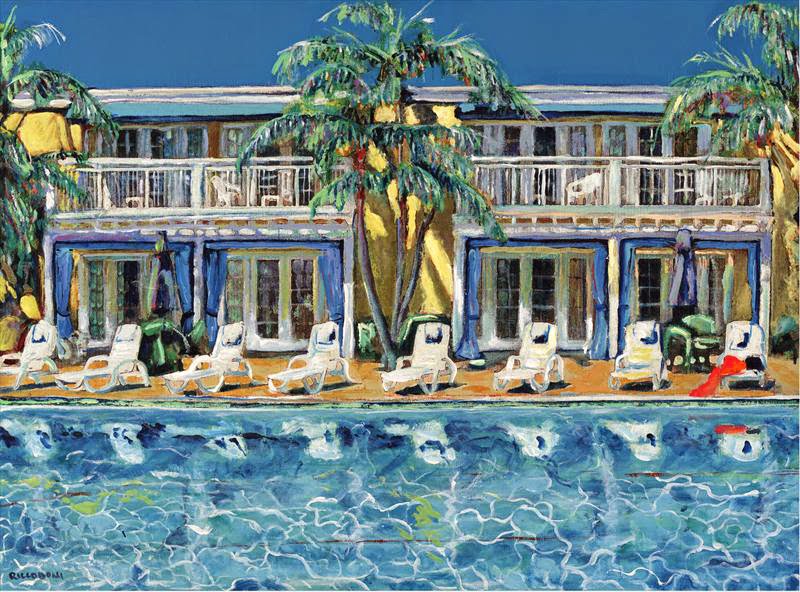
RD Riccoboni (Shimmering Poolside, below):
San Diego, in the big city sense, is a good example of capturing moments of the elusive dream of forward thinking: I pick up on the positive sense of place in vibrations of color, contrast, perspective and spirit that surround our daily lives in the historic places and landscape that I have come to love. 

A Sampling of Images at L Street Fine Art (of a total of 70 images at L Street Fine Art and the Oceanside Museum of Art)
  

Robert Avon Lees / The Return
Ken Goldman / Totally Fried

Amber George / Otay 1


Julianne B. Ricksecker / California Gold


RD Riccoboni / Shimmering Poolside at the Lafayette 

Rita Shulak / California the Beautiful

Robert Pendleton / Window

Julie Ann Stricklin / Pacific Patriot

     Margaret Larlham / Mission Dam

Shuang Li / Tideland Park

Rosemary Valente / Earth, Wind and Fire
The artists exhibiting at L Street Fine Art are:  Rebecca Bauer, Bre Custodio, Paula Des Gardins, Richard Dowdy, Amber Foote, Helen Garcia-Shafer, Amber George, Ken Goldman, Jim Hornung, Mark Jesinoski, Kirby Kendrick, Margaret Larlham, Robert Avon Lees, Anita Lewis, Shuang Li, Chris Martino, Glen Maxion, Connie McCoy, Joe Nalven, Diane O'Connell, Robyn Oliver, Rob Pendleton, Robin Raznick, RD Riccoboni, Jullianne Ricksecker, Rita Shulak, Julie Ann Stricklin, Michael Taylor, and Rosemary Valente.

What's your dream? Is it about San Diego? Join the conversation and explore the San Diego Dreaming exhibits.


628 L Street, San Diego, CA 92101
director@lstreetfineart.com
Daily:  9:00 a.m. to 4:00 p.m. daily and by appointment
Reception -- June 6, 2015  /  6 - 9pm
Exhibit dates: March 30- June 30, 2015


704 Pier View Way, Oceanside, CA 92054
(760)435-3720
Tuesday – Saturday:  10am - 4pm
Sunday:  1pm - 4pm

Exhibit dates:  February 28 - June 21, 2015

The artwork at L Street Fine Art was curated by Kay Colvin, while that at the Oceanside Museum of Art was curated by Malcolm Warner.

This article expands upon the article appearing in the Times of San Diego:   Local Artists Display their Varied Dreams of San Diego, March 10, 2015.

Joe Nalven's image, A Pueblo Tourist Visits the San Diego County Fair, is at L Street Fine Art.