Saturday, November 8, 2014

Hanan Harchol: Expressionist Animator at the Gotthelf Art Gallery

Hanan Harchol is an animator, but much more than that. He animates and illuminates his stylized expressionist drawings with Jewish dialectic:  Harchol's stories are composed of conversations between parents and children that harken back to Torah and its commentators; these are the conversations that have lasted for thousands of years.

At the same time, one might think of other duos of dialectic - from the comedic (Abbot & Costello, Burns & Allen, Penn & Teller) to the serious (Socrates and his students or fellow Athenians, Chuang Tzu & Huizi, or the paired learning of chavrusa). 

Learning can follow the professor at the podium and the student in the class model, or the more intimate and relational approach of the mentor, apprentice or peer. There is also the 'family' (or kinship) in its various manifestations: the nuclear family, the extended family, the lineage and the clan. However our society constructs the 'family' (whether in hunting and gathering society, tribal society, industrial society), we consider the 'family' is among the psychic forces that helps glue society together. We also think of social breakdown and anomie as linked to the disintegration of the 'family.' 

In this sense, Harchol's family dialogues have a universal appeal even with the societal nuances identified above. These dialogues are not just Jewish family dialogues although accents and looks and key phrases provide a specific cultural context. 

Together with the strong expressionist style, his dialogues take on the perspective of a "psychological narrative painter." 

Hanan Harchol / Landlord / Forgiveness

Jewish Food for Thought:  The Animated Series by Hanan Harchol

Gotthelf Art Gallery
San Diego Center for Jewish Culture
Lawrence Family Jewish Community Center
Jacobs Family Campus
4126 Executive Drive
La Jolla, California 92037
Tel. 858.457.3030

December 10, 2014 - February 25, 2015
Hours:  9 am to 5 pm (daily except for Saturdays & holidays)
FREE

Jewish Food For Thought is a collection of animated shorts that
teach Jewish ethics to adults and teens using thought provoking
and funny conversations between animated versions of Hanan and his Israeli parents. Each episode focuses on a particular theme such as forgiveness, love, or gratitude, distilling major Jewish teachings on that theme into engaging conversation. The series offers a fresh approach to accessing and applying thousands of  years of Jewish wisdom to contemporary life.

The animated dialogues come with study guides written by Rabbi Leora Kaye. These guides help focus the discussion, whether for the classroom or informal discussion groups.

For example, in the midst of the animated dialogue on Forgiveness, Harchol poses the following scenario:


DADDY: "Actions lead to feelings."

Hanan’s father goes on to say:

DADDY: "Stopping an action is not the same as taking an action. To free yourself from the resentment, you need to take action."

5. What does “actions lead to feelings” mean? Can a feeling “grow” as a result of an action? Do you agree that there is a difference between stopping an action and taking one? Can you think of times in your life when stopping an action actually was an active choice? Is there something in-between? Do actions lead to feelings or is it the other way around? Which should be the driving force?


This action/feelings issue was noticed by "the psychologist/philosopher William James [who] was one of the first theorists to notice this counter-intuitive process. He believed that emotions arise out of the bodily actions we take in response to what is happening in our lives. It is not, he theorized, that, 'we lose our fortune, are sorry and weep; we meet a bear, are frightened and run; we are insulted by a rival and angry and strike.' In fact, he argued, 'this order of sequence is incorrect...the more rational statement is that we feel sorry because we cry, angry because we strike, afraid because we tremble.'"

"James argued that without some kind of bodily response (crying, trembling, striking) we would not feel emotion. 'We might then see the bear, and judge it best to run, receive the insult and deem it right to strike, but we should not actually feel afraid or angry.' While over simplifying somewhat, he was still onto an essential truth. Behavior can create emotion.'" (Emphasis added.) From an article by Noam Shpancer, Insight Therapy. 

To be sure, this action-first-which-then-leads-to-understanding approach appears in Exodus 24:7 (na'aseh v'nishma). Whether one follows Torah or American philosophy, this and other theoretical underpinnings in Harchol's animations and study guides are fruitful to those who wish to investigate, explore and reflect further on this ethical subject matter.


Hanan Harchol / Landlord / Forgiveness

Joe Nalven:  How do you see the process of learning from others – especially as a dialog?

Rabbi Abraham J. Twerski:  My first association was Calvin and Hobbes.  [The Jewish tradition features] the Seder:  Reciting the account of the Exodus requires that the children (or wife) ask the four questions, because the impact is greater in the form of a dialog than by straight narration.


Hanan Harchol / Landlord / Forgiveness
Engaging with Harchol's animations and Rabbi Kaye's study guides is a multi-layered experience. And, the surprise is that if you go down this path, you may find that the adventure does not end at the end of the animation. 

The case of envy and looking into other people's windows is a dialogue that stops short of where I would like the dialogue to go. Imagine the difference between a social worker who monitors the case of a single individual or family helping the person or family to make a positive adjustment (help to get a new refrigerator, to get Section 8 housing and the like) AND the social worker as community organizer who goes out into the community and preaches social action. Schools of Social Work allow for these different tracks:  psycho-social care versus socio-political action.  In the Envy animation, we are treated to the former - a turning inward for dealing with the consequences of envy: Thou shalt not covet thy neighbor's car or girlfriend is not merely a proscription for social harmony, but a way to soothe the beast of temptation.

Then there is the question of envy as redistribution of wealth in order to exact a sense of fairness - but is such 'fairness' - as a socialized form of envy - any different that coveting thy neighbor's goods?  This scenario about envy requires a Part 2 to the dialogue - actions that go well beyond looking into someone else's window.

Hanan Harchol / Jewish Food for Thought
Finding time away from being a high school teacher as well as a classical guitarist, Harchol benefitted from the support of the The Covenant Foundation. Hopefully, we will enjoy many more Harchols from thoughtful benefactors, bringing together art and cultural values. 

Reception at the Gotthelf Art Gallery and a Torah study session at CBI 
Hanan Harchol's art exhibit at the LFJCC Gotthelf Art Gallery began with a reception and continued on to a presentation of his latest production, Faith.  His schedule included meeting with students and faculty.

Reception at Gotthelf Art Gallery
Concluding his stay in San Diego, Harchol led Torah study at Congregation Beth Israel. Both Harchol and the participants discussed the weekly parsha Vayeishev  (Genesis 37:1), comparing Joseph to Abel as each confronted envious brother(s). 

Torah study at Congregation Beth Israel


Sunday, November 2, 2014

Photographic Conversations at MOPA: Deborah Klochko and Andy Grundberg

A conversation is worth having about San Diego's Museum of Photographic Arts' (MOPA) new Center for Visual Learning. 

Deborah Klochko and Andy Grundberg
Deborah Klochko, the museum's director, and Andy Grundberg, currently a professor at the Corcoran College of Art + Design in Washington, D.C. have likely engaged in that discussion over time, and now have shared that conversation with the wider public (October 30, 2014).  

Here's the concept:  Given the impact of the internet, of software editing programs and new camera technology (including the advances in cell phone cameras), as well as the sheer flood of captured images that may not even be printed, what would be a fruitful way for institutional participation and mediating this new world of photography. The Klochko/Grundberg conversation provided a looking glass into this possibility.

The following are several of the topics from that conversation together with my own reflections. Any misstatements are those of this author and for those I offer my apology in advance.

Transitions in Style and Technology
Grundberg identified two major transitions in photography over the last 50 years. First came the shift away from 'traditional' imagery: from the Paul Strands to the Cindy Shermans. Second came digital technology. Analog photography retains a historical place and may spark a retro fascination; however, the ubiquity of digital photography is so profound that we may forget its presence.

Digital editing tools, like Photoshop, began with algorithms trading on the expertise of photographers such as Ansel Adams. However, from my perspective, as one who has survived the successive improvements of these editing tools, the possibilities now far exceed what photographers could do in the darkroom. Digital painting became possible, along with transforming shapes, presets and filters and numerous lighting adjustments were added as well as stacking more than 50 layers in what might be called a vertical silo that could apply a variety of blend modes and montaging of elements across these layers. Digital editing tools may use photographs as resources but paradigm is quite different from the chemical darkroom or even the early digital darkrooms. Even my writing what can be done in such editing tools may read like a foreign language to those not immersed in this manner of image making.

Corporate and Government Uses of Camera Technology (e.g. war, facial recognition software, CCTV)
Grundberg explained his concern with private and public sector uses of new camera technology, whether with Google or the NSA. There is that rumbling about the loss of privacy when faced with novel marketing techniques and/or the intrusion into our daily lives in order to protect the public weal. Grundberg concluded his presentation with examples of  how government was using new camera technology. Cities in England and Scotland have employed massive use of CCTV technology (outdoor cameras to cast a watchful eye over what happens on city streets). Snaps at Abu Ghraib by U.S. soldiers made their way on to posters in Iran to images from drones being placed on the internet as if they were Instagram images, but called Dronestagrams.

October 11, 2014: A drone strike in the Khyber region killed four people, including Sheikh Imran Ali Siddiqu, 
a senior figure in the newly created al Qaeda in the Indian Subcontinent (AQIS) 
at Tirah Valley, Khyber Agency.   10:50 am  •  13 October 2014 
Yes, these are interesting instances of government use of new camera technology, but the discussion would have been more useful if Grundberg included other uses, especially where the public needs to be alerted to the distortion of 'reality':  for example, the fired Reuters photographer with his visual reportage of the war in Lebanon; he had used software editing  to invent more bombings than had actually occurred; also, the current exploitation of social media by fanatical ISIS propagandists with their posting of videos of beheadings of U.S. and British journalists and aid workers. Such would have made for a more robust presentation of the uses and abuses of camera technology. All of these instances, and more, are important to a discussion of visual literacy. 

A Center for Visual Learning
Given the transitions taking place in photography, the question becomes 'So what is to be done?' 

Klochko remarked that - from an individual's creative perspective - the artist should continue making new work since there are no guarantees to being noticed. 

From an institutional perspective, such as a museum dedicated to this outsized cultural phenomenon, there is an opportunity to create a platform for interpretation - a center for visual learning as it were. Klochko said that the content for such a center is largely present in what is currently available at MOPA; however, as I understood the drift of her remarks, that to be successful, the center's activity needs creative leadership in making it tangible and relatable.

One difficulty that Klochko acknowledged from MOPA's Teen Engagement program was that many teenagers did not feel the need to exhibit their work on museum walls; rather, their interest was posting their work to YouTube.  Other museums have experimented with a variety of ways to capture an audience; others have studied the competing pull of cultural events and places (from TV, movies, museums, performing arts, online, etc.). So, an important piece of what the Center is an ongoing conversation and a persuasive framework for the variety of communities snapping those millions of images and the much smaller set who are crafting images with aesthetic impact.

We  might all ask:  If there is a rush to the internet, whether with selfies or usies or cameras that post instantly to Facebook, Instagram, Flickr, Tumblr and the like, how important is visual literacy? If one stands in the middle of a river of images .  .  .  It is a difficult thought to imagine.

I appreciate the importance of visual learning in the class that I teach in anthropology - visual ethnography often provides more of an impact than text alone.  Outside my teaching, and part of my digital art interest (much of which is sourced from photography), the structure and vibrancy and immediacy of an image is compelling. Learning from others, experimenting, and finding my own way of seeing forms my personal challenge - whether as a dinosaur interested in a Paul Strandian look or as an interstellar being who is unfortunately trapped inside a human being. The challenge is moving the image outside my mind and into social discourse. 

Klochko's direction is an important one for institutions to grapple with the revolution going on in photography (at least in the technology and communication of images). For others, like the teenagers and young adults who are fascinated with YouTube, Twitter, Instagram, Facebook, a Center for Visual Learning remains a question mark. For others, like myself, the Center may become part of a multi-centered conversation, one part of which is listening in on conversations such as the Grundberg/Klochko one and then expanding upon it with fellow artists, students, gallery owners, and the general public

Read a complementary artblog concerning a small business response to transitions in technology:  Master printer and the evolution of fine artprinting: Mark O'Donnell and Pixel2Editions

An opportunity for students to ask questions

Master printer and the evolution of fine art printing: Mark O'Donnell and Pixel2Editions

Like many artists who do printwork, I have used a variety of digital inkjet printers.  Over time, I decided the hassle of maintenance and upgrades, the wide variety of papers and inks, as well as the expectation of editions led me to the inevitable:  Let someone else do the printing. 

There are many print services available, locally and online. However, I am an experimenter and most print services do not want to spend time with a one-off experiment that might or might not lead to more work. There are some exceptions.  Mark O'Donnell at Pixel2Editions is willing to work with fine artists on small runs, partly because he is also an experimenter and a painter.  

Part of my journey in art was walking into Pixel2 and seeing a metal print on the wall. The metal print was really an image printed on mylar and then laminated onto distressed metal. The metal print had been damaged and so the discarded artwork became an objet d'art - a wall object. I was fascinated and commenced to distress metals with patinas and get them printed and laminated. 

This is the adventure of walking into Mark's business and his experimenting with new technology or old technology optimized in new ways.


Joe Nalven:  How long have you been working with printing machines?

Mark O'Donnell:  I started with an advertising company in Chicago in 1991 right after art school. I mostly worked in the color proofing area with silk screening. After purchasing the first (and second) Iris printers in Chicago for color proofs, we were asked to print on shrink wrap in order to pitch soda can ads for Leo Burnett. The Iris, which was the first fine art printer, had dye inks which you could actually drink! The lack of stability and inability to adhere to non- coated substrates presented an excellent challenge for us to print on unique media. We were forced into extensive R & D in uncharted territory. By using combinations of emulsions in the color proofing department we came up with what would be the first inkjet coating allowing us to print on virtually anything. 


The process was then shared with Nash Editions in Manhattan Beach in return for ideas on how we could retrofit our Iris, which was like theirs, to be able to print on thicker media such as watercolor papers. Today I believe that the Iris printer Nash had is in the Smithsonian Institution.

Mark O'Donnell / The flatbed printer optimized for fine art

Joe Nalven:  Why the new flatbed printer?

Mark O'Donnell:  The new flatbed decision came about when we finally saw decent resolution and density for fine art printing. Flatbeds have been around for a long time, but this model made the choice easy. While incorporating a white ink, these UV cured inks last a very long time outdoors. This is indeed rare combination to have a good color gamut, resolution, longevity, and white, spot white, or varying opacities of white.

Joe Nalven:  You're also a painter.  Has your printing influenced your painting and vice-versa?

Mark O'Donnell:  Coming from a painting background my strong point is what most clients regard as our company’s strength - the ability to see and match color while paying close attention to detail and quality. Sometimes I see this as a curse because I find myself spending all my time on other artists’ works while little to no time on my own easel! 

Joe Nalven:  What are you planning over the next 5 years?

Mark O'Donnell:  In our field five years represents an incredibly long time. We only look at year to year for major decisions because technology changes so rapidly. Who is to say where we’ll be in two years let alone five? This said, UV direct printing will only get cheaper, better, and faster so we are constantly looking into the latest models that could fit our needs. We hope to eventually evolve into a Gallery, with the printing facilities obviously still taking center stage. We will be purchasing a new online store front to compete with companies such as Fine art america and picture it on canvas. The difference we’ll have will be to pick and choose the artists we’ll represent and we will continue to reproduce with the finest papers (and other surfaces), inks, and machinery. 

Joe Nalven:  Who would you consider to be to be a major influence in your life and work?

Mark O'Donnell:  I would have to say believe it or not, not an artist! Dr. Martin Luther King jr. said something which gave me pause and I feel is one of the greatest quotes. I continue to live my life based on this:

If a man is called to be a street sweeper, he should sweep streets even as a Michaelangelo painted, or Beethoven composed music or Shakespeare wrote poetry. He should sweep streets so well that all the hosts of heaven and earth will pause to say, 'Here lived a great street sweeper who did his job well.

Mark O’Donnell
Pixel 2 Editions, Inc.
858-549-7299
www.pixel2editions.com


Read a complementary artblog concerning an institutional response to transitions in technology:  Photographic Conversations at MOPA: Deborah Klochko and Andy Grundberg

Monday, October 20, 2014

A fine, fine ceramics exhibit – a merger of new technique, concept and curriculum

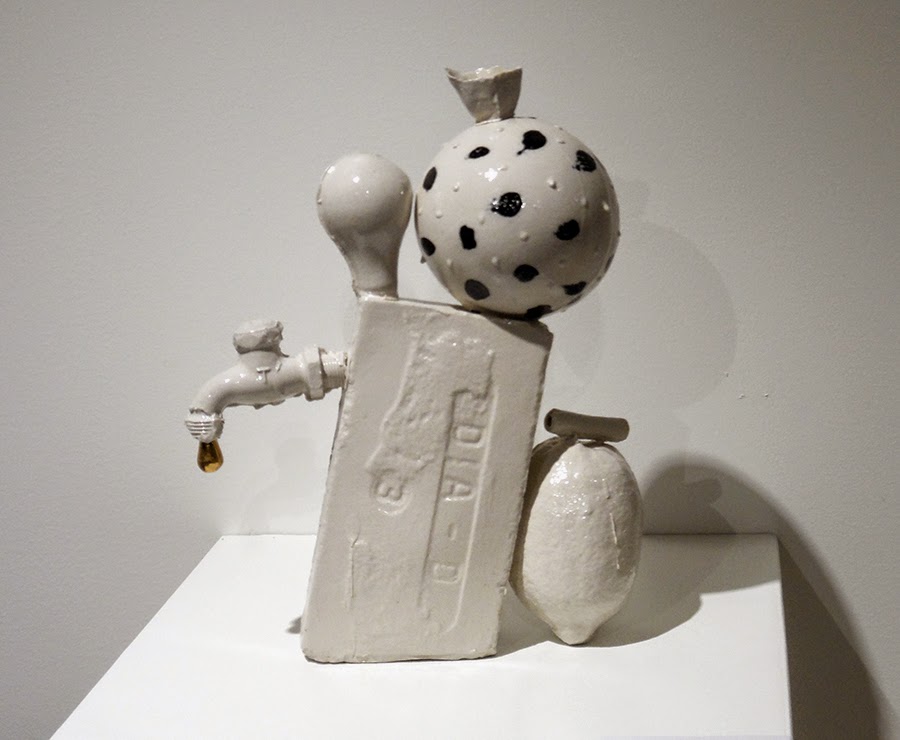
Yoonchung Kim has curated a world class ceramics exhibit at San Diego City College’s new art gallery.  Casting Plus brings together Korean, Chinese and U.S. ceramic artists – all of whom are getting us to rethink the possibilities of this medium. The works capture a range of emotions and ideas, beyond the expectation of the pretty, the glazed surface and the collectible.


Casting Plus / Gallery Panorama
Kim notes a programmatic aspect of Casting Plus: "This exhibit has an added dimension of launching a new curriculum for Art Entrepreneurship to help fine art majors add skills for making a living in art related businesses. These classes do not help you learn art quicker; we want our students to be able to make a living as artists and designers. Four year university education generally does not include the business end as an artist."


Jeff Irwin / Win, Place and Show / Earthenware 2014
I use a white satin glaze on the surface to support the subtleness of the forms and strengthen a sense of
simplicity, clarity, spirituality, and transcendence between life and death. Inspired by animal trophies
and twisting tree branches I have created a series of all white tree-like animals, which are meant
 to represent our manipulation of nature. For me the work alludes to power, ego, preciousness and loss.
  Using a relatively fragile material like clay to create this work serves to reinforce my message
of the fragility of nature. In Win, Place and Show, these trophies allude to competition and the need to win
as well as depicting our use of nature to entertain and enrich ourselves.
Joe Nalven:  How should we think about ceramics?

Yoonchung Kim:  Ceramics is a medium that can combine sculptural and painterly art works, but at the same time ceramic outcomes depend on firing and glazing. Glaze and underglaze include many chemicals for colorants. Ceramic requires many types of equipment for firing and glaze making. Other sculpture works also require a variety of equipment, like saws, drills, welding, and casting equipment. We are fortunate that we have been getting some advanced equipment with our new building.

For this exhibition, I included artists who use CNC (Calibrated Nozzle Changers), 3D printer for the shapes and laser printer or color laser printer for the surface imageries. These technologies also help the making of multiples faster - which is the way the casting technique is mostly used.

Haesin Ro / Sphere
The work implies a variety of different colors in the controlled shapes. The artist attempts
to create a reciprocal relationship between form and color. Furthermore, color is observed as a means
to express different emotions. Color also insinuates movement, weight and atmosphere.
The process of making is both delicate and complex, requiring patience and time.
The work is made using the slip-casting technique and the pieces are colored by painting
slip directly on to the molds.
Richard Burkett / California Drought Tea Pot / Soda fired slip-cast porcelain / 2014
JN:  With the new Art Entrepreneurship curriculum, I wondered how your sabbatical to Korea and China influenced this curriculum - and, on a personal level, what was the give and take in your working with Korean and Chinese ceramicists?

YCK:  In Asia, ceramic casting is a big part of university education. In the U.S., we emphasize the one of kind, the fine and conceptual ceramic piece. Bringing more of the Asian approach to our institution was what I planned before I went on sabbatical to Korea and China for a year. I learned many technical casting techniques while I was sharing the studio with an artist who has worked casting works for 25 years. In return, I taught image transfer techniques including silkscreen and decal making. My work is always about conceptual approaches with casting techniques; that was part of what I taught when I was in Korea.


Casting Plus: International Ceramic Exhibition
Current work by 15 artists from US, Korea & China
City Art Gallery:  San Diego City College
1508 C Street, San Diego CA  (Street parking nearby)

Gallery hours:  Tuesday, Wednesday, Friday:  12 noon to 4 pm
Thursday: 3 to 7 pm, and by appointment
Oct. 7 - Nov. 4, 2014
Free 
Contact:  Yoonchung Kim:  ykim@sdccd.edu


Mikyung Kim / Stoneage Ware / Porcelain 2014
Terri Hughes-Oelrich / Untitled / Slip-casted clay in molds 
 
Nancy Selvin / Findings #010 / Clay 2010

Lesley Baker / China Flowers
My work is greatly influenced by architecture, the history of ceramics and the quality of
 the porcelain. The floral motif inspired by wallpaper patterns represents the history of place
 and the desire to make things beautiful by mimicking nature. The cast porcelain pieces are
 assemblages of collected forms that redefine the meaning of the object. Scale becomes
 like memory, distorted by time, some larger than life while others are buried. 
Personal history and desire colors the view and projects unique meaning. 
Clay has the endurance to record civilizations, a purity that can let light through, 
and a fragility that demands gentleness. It has the magic of seducing the artist by
 never fully revealing all its secrets.
 

 Seung Wook Hwang /   Canon G35C (left), Polyhedron (right) / Slip Casted Porcelain 2009
I make ceramic works using digital technology such as CAD/CAM and CNC machine. 
Precise form made by using the machine has other charms different from exquisiteness
 and perfectness of the form made by a skillful craftsman. I think that the tools and means 
not only bring the differences in outcomes but also converts the aesthetic decision 
and the way of thinking of the maker. Because things made by using such digital technology 
are related to almost all the lives of people, the attempt to use the digital technology 
for ceramics work has the meaning of the record of aesthetic trend 
and formal tendency of our age.

Yoonchung Kim / Frozen Perspective
JN:  How do you think of your own work?

YCK:  A common thread I had in most of my work are time as a visual element and the scale beyond human perception. The eternal time span of Earth compared to human life and the incredible size of nature compared to the human scale make my existence and art making temporal and humble.

I am fascinated with nature's lasting power and vastness; this is manifested strongly in my works. The eternal enormity of the Alaskan glaciers, powerful ocean and its waves dwarf me. Vast dried earth and sands cleanse me. When I am with nature, I find myself peaceful and spiritual.

Many things in my life have evoked a thought of death as the moment of returning to a primal element such as earth's dust.

Geometric forms from the man made environment are combined with natural forms and organic textures. Harmony is created in contrast: nature versus human, mortal versus immortal, object versus primal element.

Yoonchung Kim /  J's Memory

I am re-defining the concept of human scale and time from a different perspective.

Sometimes the meaning of my work may be ambiguous to the viewers, but I encourage the viewers to have their own interpretation of my works.  I believe they will relate my works with their own views of life. As Marcel Duchamp said, "The viewer completes the creative cycle." 

It doesn't seem that the field of ceramics is static. There seems to be a dynamic energy driving this show -- not only in the vision, but the materials and technology. 

Is this what we are seeing?

The artists in the exhibit are:  Jin Baek, Leslie Baker, Richard Burkett, Seung Hee Lee, Soonjung Hong, Terri Hughes-Oelrich, Jeff Irwin, Jihye Kim, Mikyung Kim, Yoonchung Kim, Nancy Selvin, Hae Sin Ro, Paula Winokur, Seung Wook Hwang, Sol Yoon. 

The images shown in this blog are only a sample of the robust collection of pieces. Each one is worth seeing in this world class exhibit.