Showing posts with label art. Show all posts

Sunday, June 14, 2015

Oddities and Attractions: A Museum Travelogue at the Whitney, Met, Neue, NYPL, Quebec's Museum of Civilisation and Montreal's Beaux-arts

At a question and answer session, the visiting juror said - with emphasis - that her venue would rarely curate a travelogue exhibit. You can guess why:  too many 'I was here,' too many places rather than art styles, too many trifles and oddities about weird cultures, and perhaps too many selfies. 

But what if the travelogue was about oddities in art museums? Not so much a comparison of current shows, but rather what makes these museums attractions for the curious mind.
 
Considerations for the curious mind
I imagine curators must struggle to get beyond art-for-art's sake: showing the outrageous for the sake of being outrageous; reflecting upon the glory of the artist as enfant terrible; a journey into the past; or maybe engaging the audience with a playful intent. 

I'm helped along when curators put their thoughts onto wall tags (and nowadays putting them online as well). The following images are from a half dozen or so shows I recently saw. This selection could be taken as advice to go forth and see these shows but it is more about how we can re-energize the exhibits here -- whether 'here' is in San Diego or elsewhere -- and bring this playfulness into the work we exhibit. Imagine the concept of 'portraiture':  it could become a tired framework for exhibits; or, it could be reimagined and compel us to think what is was that led us to think that category of presentation had become dull.

Animation and Dance at Musées de la civilisation (Museum of Civilization)
Quebec's Museum of Civilization was a different kind of adventure. In one area, the imaginative and provocative animated short films of the National Film Board of Canada (winner of several Acacemy Awards) was clustered into several areas, illustrated by models of various materials, drawings and odd sorts of camera work. Frame X Frame was a glorious exhibit in terms of the variety of subject matter, techniques and the opportunity to watch the films unfold. It would have been far more difficult for full length features.

Clay figures / Objects for an animation

Somehow, the short films seemed current even if the pictured imagery was from another era. 

Lipsett's short (Very Nice, Very Nice - see below) is spell-binding. The online inventory of many of these shorts allow us to engage with these materials,

From Wikipedia:  "While working at the National Film Board, Lipsett collected pieces of audio from the waste bins and pieced them together as a hobby. When his friends heard the product of this they suggested that he add images to it. The result was this film. It was nominated for the Academy Award for Best Short Subject, Live Action Subjects in 1962. Despite not winning the Oscar, this film brought Lipsett considerable praise from critics and directors. Stanley Kubrick was one of Lipsett's fans, and asked him to create a trailer for his upcoming movie Dr. Strangelove. Lipsett declined Kubrick's offer. Kubrick went on to direct the trailer himself; however, Lipsett's influence on Kubrick is clearly visible in the released trailer."

Arthur Lipsett / Very Nice, Very Nice (1961) can be seen on YouTube

In another area of the Museum is an equally compelling exhibit about contemporary dance:  Rebel Bodies. The goal of the museum exhibition was intended to "demystify contemporary dance." Instead, I was entranced -- to be more exact, I was mystified. The variety of approaches was splashed on numerous large screens, exhibiting both the dance and the choreographer's commentary. The online resources are hard to locate, but Victor Quijada's experience and innovative dance, the RubberBand Dance Group expands upon his philosophy of dance in Rebel Bodies.

Rebel Bodies -Victor Quijada

Culling the Collection to Consider a Puzzle:  The (new) Whitney Museum of American Art's America is Hard to See

The Whitney pulled art from its collection of 'American' art (artists who were born in America and/or did their art in America) and organized it in its new multi-storied building. The story of American art from the beginnings of the 20th century are organized in chapters, such as Forms Abstracted, Music-Pink and Blue, Free Radicals, Scotch Tape and the like.

From the Whitney website: The title [of the inaugural exhibit], America Is Hard to See, comes from a poem by Robert Frost and a political documentary by Emile de Antonio. Metaphorically, the title seeks to celebrate the ever-changing perspectives of artists and their capacity to develop visual forms that respond to the culture of the United States. It also underscores the difficulty of neatly defining the country’s ethos and inhabitants, a challenge that lies at the heart of the Museum’s commitment to and continually evolving understanding of American art.

The new building provides an opportunity to revisit those many niches in which artists have expressed their visions. The historical romp through the decades provides enough material in each chapter to give the viewer a sense of time, place and reflection. The availability of docents on several floors adds to the organizational presentation of this pluralistic enterprise. Most of the works on exhibit can be seen at Whitney online.

Viewing an exhibit drawn from the images of individuals with AIDS; see the 2013 exhibit I, You, We
The presentation of social activism that runs through the Whitney Museum's exhibit reinforces the artist's ideology - for better or maybe, not.  Below, the Metropolitan Museum's China/Asia exhibit takes a more informed approach to the ideology of the times. (See discussion below.)

Room with 3 videos (left) / Christopher Wool / Untitled (Run Dog Run) (R) with photographer inside room shown at left

A place to view what fascinates the viewer
Jonathan Borofsky / Running People (on the wall) - and a place to relax and sit

Upending the Stereotype and Confronting the Academic: The Metropolitan Museum of Art's exhibit - China, Through the Looking Glass

The opening curatorial remarks in the wonderfully juxtaposition of Chinese antiquities and Western high-fashion designers confronts the facile condemnation of Orientalism. While national and ethnic stereotypes truncate our understanding and appreciation of other cultures, such stereotypes can be re-interpreted and played with -- as a commentary on way in which we fail to understand one another and, yet, the possibility of figuring out how to reconfigure the pathways behind these stereotypes. (Compare this approach to the Whitney Museum's presentation of art by social activists -- see above.)

As an undergraduate at Columbia College in the early 1960s, I enjoyed the class Edward Said taught on the works of Jonathan Swift. I lost track of Said's work and was surprised to find his book on Orientalism referenced at the beginning of the Met's China exhibit:  "Said interprets Orientalism as a Eurocentric worldview that essentializes [ie. narrow stereotype] Eastern peoples and cultures as a monolithic other." The curator's notes argue that this exhibit of juxtapositions provides a doorway into rethinking the West's encounter with the East - a more positive and flexible one.  As a cultural anthropologist who addresses such stereotypes in an introductory course, my personal view was that this pathway is a productive one for looking the "other" through a multi-faceted lens and realizing that we, too, are the "other."

Antiquity (left) versus high fashion (right)
The Metropolitan Museum China exhibit:  "The exhibition features more than 140 examples of haute couture and avant-garde ready-to-wear alongside Chinese art. Filmic representations of China are incorporated throughout to reveal how our visions of China are framed by narratives that draw upon popular culture, and also to recognize the importance of cinema as a medium through which to understand the richness of Chinese history."

I could not get the Buddha's image out of my mind (image on right)

One can't help but appreciate how an image of a spiritual force in a culture (Buddha) can be visualized in a multitude of ways without provoking anger and violence -- unlike the inability of other cultures to allow such visualizations.

New York Public Library: A novel way to reinvent a photographic collection
Most of the photographic exhibit is drawn from the large collection held by the New York Public Library. What brings additional life to the exhibit (beyond the historical materials) are two interactive exhibits: the first is the novel entryway where the attendees become part of a constantly changing framework seen in the large mirror hanging above (i am in the public eye); the second is an interactive display that aggregrates the activities on those who inhabit Broadway.
i am in the public eye (the text is in reverse on the floor and reversed when one looks into the mirror hanging above)

Depending on where one stands below - whether in the area framed by the mirror or off to the side - and where the attendees pass by below the mirror, there is an ever-changing composition with some looking up at the mirror, others wandering unawares below, some simply looking and others, like myself, captivated by the area seeking a novel place to photograph the composition.  That frame of mind is captured by the text on the floor.

On Broadway:  "The interactive installation ON BROADWAY represents life in the 21st century city through a compilation of images and data collected along the 13 miles of Broadway that span Manhattan. The result is a new type of city view, created from the activities of hundreds of thousands of people." On the left: a slice of the moving set of images with data flow represented in bands of color; on the right: by pressing the lower row of images, the upper portion enlarges to enlarge the set of images surrounding the individuals on the lower row.
The On Broadway exhibit seems to attract less attention likely as a result of the intense amount of information presented. Hopefully, this effort to capture sense of the environment (in this case, Broadway, NYC) is replicated in other places. I can imagine each city have an information map that says "You are here" and adjacent to finding where you are in the simplified map that we all need to orient ourselves in a new place is this blooming, buzzing organized data flow that is THIS city (ie. whatever city one is standing in) - an immediacy effect of experiencing where you are in digital data.

Juxtapositions of form and content:  Defining the human perspective at the Montreal Museum of Fine Arts 

The Montreal Museum of Fine Arts' collections range from archaeology and world cultures to the decorative arts to photography and design. The Museum boasts as having one of the first encyclopedic collections in North America. However, what struck me among the expected and usual fine art objects, were two items that bracketed my experience of walking the museum; these were startling in very different ways.

First was Tony Matelli's Old Enemy, New Victim. It seemed repugnant. And it was, and it is.

Matelli uses silicon and yak hair to create a hyper-realist act of violence. The artist says, "I am interested in culture, not nature." But, we might wonder, what is the difference? Is the only difference yak hair? 

Tony Matelli / Old Enemy, New Victim

On further reflection, I am less repelled by Matelli's sculpture when I consider fabulous paintings such as Judith Slaying Holofernes by Artemisia Gentileschi or images from antiquity such as the Death of Pentheus, torn apart by Bacchantes on the wall of the House of the Vettii in Pompeii. Then there are the horrors of real historical figures such as the 15th century Vlad III, Prince of Wallachia who impaled thousands of subjects. 

Is this Matelli's not-so-subtle message about humanity? Worthy of many a conversation.

Looking outside through glass art and glass window, looking out from the museum into the city


The Artist Prank: Butting heads with the walls that define art history

The Neue Gallerie showcases Gustav Klimt's painting, Portrait of Adele Bloch-Bauer I (aka Woman in Gold). But travel upstairs and find the artist prank that preceded Marcel Duchamp's Fountain by about five years. 

Not as well known, and upstairs from the Klimt exhibition, is an equally interesting exhibition. The Neue juxtaposes German and Russian artists from the early 1900s: Russian Modernism: Cross-Currents of German and Russian Art, 1907-1917. I would have liked the Neue to have posted images from this exhibition online. (Other holdings are viewable online.)  Still, one of the curators' notes stays with me. The collaboration of Natalia Goncharova and Mikhail Larionov was a benchmark worth knowing. They formed a rejectionist (of Western art) group known as The Donkey's Tail. Here we find rebellion against the perceived confines of Western art. However, the thrust of the Russian pranksters appears to have been aimed at finding a truer Russian narrative in their paintings rather than to question the very notions of art as set out by the Dada-ists, the readymades and singular Fountain of Marcel Duchamp several years later.

Note about the Donkey's Tail from InCoRM:  “The name, “The Donkey’s Tail”, derived from a famous Parisian hoax in which the art critic, Roland Dorgelès and Fréderic Gérard, proprietor of the Montmartre café, Le Lapin Agile, had painted a lurid red and blue seascape by tying a paintbrush to a donkey’s tail. The work was exhibited as Sunset Over the Adriatic under the name of Joachim Raphale Baronali at the Salon des Indépendants of 1905 apparently without comment. In 1910, Ilia Repin recounted the incident of the donkey’s tail in his review of Izdebsky’s International Exhibition and used the term as a critical epithet for the modernist work on show. Shortly afterwards, the Russian press satirized the Knave of Diamonds exhibition by publishing a cartoon of a donkey painting with its tail, with the cynical caption: “Off home already after looking round just one hall. Don’t be shy. Get your sixty kopeks worth and next year come again. Then we will change the name and under the sign of ‘the Donkey’s Tail’ we will show you the way we paint our pictures.” In adopting this name for his group, Larionov beat the critics with their own stick.”

What with all the fanfare about artist pranks, we are reminded of how artists continue to chafe against the prevailing normative styles. Even Gustav Klimt took issue with the then prevailing perspective of Historicism and his joining forces with the Vienna Secessionist group: "Secession artists were concerned .  .  .  with exploring the possibilities of art outside the confines of academic tradition. They hoped to create a new style that owed nothing to historical influence."

Since we are all embedded in history, and we stand on the shoulders of those who come before us, we might ask why pranks and why rebellions? Is it that the guards at the gates of social institutions (galleries, museums, libraries, auction houses) play a dual role? To celebrate and curate the artistic literacy of the past and contemporary favored few AND to weed out the noise: that's reason enough for pranks and rebellions.

At the Neue Gallery: No, that's not the REAL Woman in Gold, that's upstairs where no photos are allowed

The museum travelogue ends; what's left for the artist to do?

I'll pass on recipes for commercial success, getting known (marketing), and becoming the next Klimt, Picasso, Warhol or the next child wonder. I'll also pass on the cliches of finding one's inner artist or the center of true artistic beingness. We all do these things, myself included.

Instead, I am amazed at all the places I visited and what I discovered (re-discovered) for myself. These are illustrations of the artist wormholes that remind us of the unfolding adventures still left to explore. 

Make voyages! Attempt them... there's nothing else. Tennessee Williams

Tuesday, March 31, 2015

Latin American Arts Festival Comes to San Diego

It is worth celebrating San Diego's First Latin American Art Festival, hosted at Liberty Station.

There have been other noteworthy exhibits of Latin American artists in San Diego; still, this framing of Latin American artists adds to continued cultural integration of artists in the north and south of our hemisphere.

Artists came from as far away as Chile. Carolina Ligouri, "It is an enriching experience, a great opportunity, not only to sell to the public, but also an opportunity to contact other artists and galleries." (quoted in VidaLatinaSD).

First Place Award Presentation to Hector Herrera
Hector Herrera / Illustrative sculptures of First Place Award / Heart in Resin (left). Face (right)
First Place Award / First Latin America Art Festival / Liberty Station 
Laura Urrea, Participating artist from Cabo San Lucas, Mexico


Aída Valencia y Gabriela Ávila DeMotta, socias de la galería Casa Valencia Galería Baja, están a la cabeza de este nuevo esfuerzo que tiene como objetivo promover el arte plástico al sur de California con piezas de pintura, fotografía, escultura e ilustración.

El jurado está conformado por Patricia Frischer presidenta del San Diego Visual Arts; Benito del Águila, organizador de festivales de arte en Baja California; Alessandra Moctezuma, directora de arte de La Mesa College; Ginger Shilick, directora de SDAI en San Diego; y Vianka Santana, directora de CEARTE en Tijuana, B.C.; además de Valencia, quien es originaria de Tijuana y cuenta con una exitosa carrera como mosaiquista y galerista.

Además de seleccionar a cien artistas que tendrán la oportunidad de exponer y vender su obra durante el festival, el jurado nombrará tres primeros lugares que ganarán 800, 500 y 200 dólares respectivamente. El primer lugar además se hará acreedor a una exhibición individual en Casa Valencia Gallery en el 2016. El segundo y tercer lugar participarán en una exhibición colectiva.

From the invitation at Vida Latina San Diego / December 2014


Sunday, March 15, 2015

Picturing a San Diego Dream: Exhibits at L Street Fine Art and the Oceanside Museum of Art

The danger of blissful dreams is that they invite others to dream those dreams as well.

And so, we have San Diego Dreaming at the L Street Fine Art  in downtown San Diego and a collaborative location at the Oceanside Museum of Art.

The artists in the San Diego Dreaming exhibits have compelling images that invoke what we believe is the magic of this community – from semi-arid desert lanscapes often disguised by the import of water; its cascading mountains of sandstone andsiltstone above the wondrous beaches; witnesses to the greenflash at sunset; native spirits in Vulcan Mountain; the mini flowers of the Anza-Borrego desert; and, of course, the Marine Corps Base at Camp Pendleton that separates us from Los Angeles and a suburbanizing coast.

As a point of reference, I came to San Diego from New York City for a two week stay. That was 45 years ago, trading in the place known as The Big Apple for the Southwestern-most-corner of the United States. 

Composing San Diego Dreams 

A persistent question:  Are the dreams of San Diego artists any different than those in London, Calcutta, Paris or New York? In many ways, the locale and its geography override the imagined mysteries of its residents; and, we would be quick to ask how different is San Diego from other Southern California surfing and beach communities or, as one moves inland, from other inland desert communities.

Several artists commentaries open the door for starting this conversation about how and what San Diego artists imagine (while allowing an open framework to connect with how and what artists dream elsewhere).

Ken Goldman (Totally Fried, below): 
Many places have fairs; each are unique to their own area. Here we get to see everything San Diego because it is a showcase for the best of so many local endeavors from art, to music, to flower growing, wood carving, rock hunting .  .   .  you name it. Even some of the fried food vendors are local.
I am not sure whether the idea of dropping off one's intellect at an entry gate to become a rube for a day is everyone’s idea of a dream day, but once a year, it's just so darn different and fun that its a dream-like day for me. Eating totally fried food that I would normally never touch, looking at livestock, chickens, rabbits, people watching and taking lots of photos of colorful people doing colorful things, especially during a warm side-lit golden California Sunset (as a basis for colorful paintings), just looking around, being away from the grind, is a California Dream. And then, at the end of the day, I always wonder where time went and leaving for home always seems a bit unreal. Yet each year we look forward to going back! 

Robert Pendleton (Window, below):
Window is an original digital image with colorized luminosity in the underexposed portion of the image.  It was taken from my bedroom window in a condo in Oceanside where I lived for a few years, and it represents the theme of San Diego Dreaming in several respects. I moved to La Jolla from Sacramento when I was 8-years old, which was just old enough for me to realize what an enchanted place I had come upon, and how fortunate I was to live only a few miles away from the beach.  I was immediately drawn to the beach, and learned to respect the ocean by nearly drowning on an occasion or two, but even so, I always cherished every trip there.  The beach was my playground; I used it to skim board, snorkel, boogey board, fish and eventually scuba dive.  I went there to watch the sunset, sit around a fire, play backgammon, and party, and my dream was to one day live in a house on the beach, drifting off to sleep each night with the sounds of the waves and the smell of the ocean air. Living on the beach is a broadly held dream, and in many ways, the defining element of the San Diego Dream. 

A few years ago I came close to realizing that dream when my ex-wife and I purchased a condo one-half block away from the beach in Oceanside.  Unfortunately I had to give the condo up when we divorced, so I spent the last few months there photographing every possible aspect of my view to the ocean, and the peculiar architecture of that building. Window was taken at sunset from my bedroom near the beach, and is a part of that series of images. Alteration of the diffracted light on the window’s edge to an unreal spectrum of color plays upon the notion of a dream as something man-made and artificial yet based on reality and possibilities.  The aspect ratio of Window and limitation of the ocean view to a narrow strip represents that narrow window (financial and practical) of my living within view of the beach, and the relative importance we place upon encasing ourselves in boxes of walls, that exclude even light, in our efforts to create a perfectly controlled synthetic environment in which to comfortably live.

Rosemary Valente (Earth, Wind and Fire, below):
Living in Carlsbad, my home has literally come close to being obliterated by fire several times. In the past 10 years there have been three threats of fire with strong winds looming within a mile of my home.  Last year in Carlsbad, I could see the fiery shapes and smell the intense fumes all too  close.  I aimed to convey this in Earth, Wind and Fire. This image portrays those horrific moments that could have brought tragedy to me and unfortunately did bring tragedy to many others. Firemen kept the fire away from our property and life goes on with our blue skies and warm waters in San Diego.

Mark Jesinoski (Emerging, below):
I moved to San Diego because I believed it was a place I could redefine myself.  My perspective of southern California, and San Diego specifically, was that it was a place where many peoples came together to form a unique culture, that was defined as much by its diversity as it was by its juxtaposition to the Pacific Ocean.  When I moved here I took a chance and completely redefined my work because I was not only inspired by the waters of the Pacific, but I had always since I was a boy in Minnesota reading Zoo Book magazine (I still have them all), been inspired by the idea of the waters of the Pacific; I perceived my relocation to San Diego to be my opportunity to define and express my identity as purely and simply as I could.  This came out artistically - because of this shift and because of the context of San Diego - in art that was inspired by water in both form and process. Water is my great metaphor for change. This is my San Diego dreaming story.  

Julianne B. Ricksecker (California Gold, below):
California Gold is an etching, a landscape view from the mountains -  driving on I-8 returning from the mountains in the late afternoon, with the golden sun illuminating San Diego Harbor, silhouetting the Point Loma land mass and Coronado and the Strand. For me, part of the San Diego dream is that I can enjoy the pleasures of nature at the beach, in the mountains, or on the desert - all within the space of a day!  Having grown up in Pittsburgh, where I dreamed about seeing the ocean someday, living in San Diego is a constant.  Of the three types of landscape, the only one I was personally exposed to as a child was mountains, and the vegetation on mountains in Pennsylvania, which are quite different from our Southern California mountains. And, I can choose to go visit snow, or not. I love the openness of the landscape and our strange and wonderful local native plants. As I am typing, just got a text from a friend that the desert is blooming, inquiring when can we head out that way?  Case in point! 


Robert Avon Lees (The Return, below):
Frank Lloyd Wright reportedly said, “All the loose marbles in the country rolled to the California Coast.” California is and has a history of migrating, expansive, open minded, searching, daring, spiritual, and beach loving individuals.

San Diego is inspiring to a dreaming visionary person. My art gravitates to the subject of science as well as to mystical and metaphysical insights. I see San Diego as a place to incubate and prosper and dream.  There is just something in the air that fosters this creative multi-disciplinary cross pollination.  The environment nurtures thoughts and visions.  My California dream painting is abstract with forms and colors as a metaphorical was of expressing different emotions, movements and qualities of life. 


The Return conveys particles moving in a unifying energy field.  The physical world, matter, unfolds out of and returns back into the deeper underlying source, spirit consciousness. 

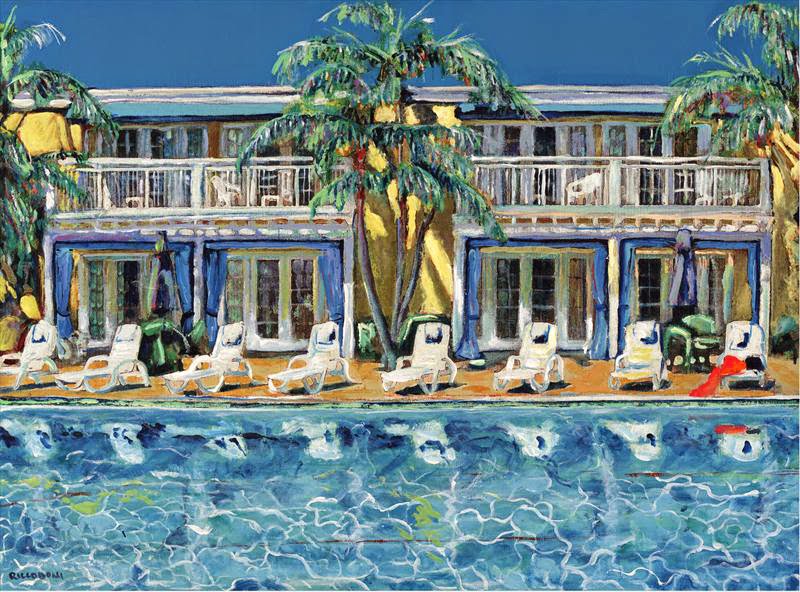
RD Riccoboni (Shimmering Poolside, below):
San Diego, in the big city sense, is a good example of capturing moments of the elusive dream of forward thinking: I pick up on the positive sense of place in vibrations of color, contrast, perspective and spirit that surround our daily lives in the historic places and landscape that I have come to love. 

A Sampling of Images at L Street Fine Art (of a total of 70 images at L Street Fine Art and the Oceanside Museum of Art)
  

Robert Avon Lees / The Return
Ken Goldman / Totally Fried

Amber George / Otay 1


Julianne B. Ricksecker / California Gold


RD Riccoboni / Shimmering Poolside at the Lafayette 

Rita Shulak / California the Beautiful

Robert Pendleton / Window

Julie Ann Stricklin / Pacific Patriot

     Margaret Larlham / Mission Dam

Shuang Li / Tideland Park

Rosemary Valente / Earth, Wind and Fire
The artists exhibiting at L Street Fine Art are:  Rebecca Bauer, Bre Custodio, Paula Des Gardins, Richard Dowdy, Amber Foote, Helen Garcia-Shafer, Amber George, Ken Goldman, Jim Hornung, Mark Jesinoski, Kirby Kendrick, Margaret Larlham, Robert Avon Lees, Anita Lewis, Shuang Li, Chris Martino, Glen Maxion, Connie McCoy, Joe Nalven, Diane O'Connell, Robyn Oliver, Rob Pendleton, Robin Raznick, RD Riccoboni, Jullianne Ricksecker, Rita Shulak, Julie Ann Stricklin, Michael Taylor, and Rosemary Valente.

What's your dream? Is it about San Diego? Join the conversation and explore the San Diego Dreaming exhibits.


628 L Street, San Diego, CA 92101
director@lstreetfineart.com
Daily:  9:00 a.m. to 4:00 p.m. daily and by appointment
Reception -- June 6, 2015  /  6 - 9pm
Exhibit dates: March 30- June 30, 2015


704 Pier View Way, Oceanside, CA 92054
(760)435-3720
Tuesday – Saturday:  10am - 4pm
Sunday:  1pm - 4pm

Exhibit dates:  February 28 - June 21, 2015

The artwork at L Street Fine Art was curated by Kay Colvin, while that at the Oceanside Museum of Art was curated by Malcolm Warner.

This article expands upon the article appearing in the Times of San Diego:   Local Artists Display their Varied Dreams of San Diego, March 10, 2015.

Joe Nalven's image, A Pueblo Tourist Visits the San Diego County Fair, is at L Street Fine Art. 


Sunday, March 1, 2015

Ever think about art law? How about mastering it?

Discussions about art and copyright infringement become the topic du jour from time to time. One often hears the rule of thumb, 'if you take less than 10% of another person's image, that's OK.' But is there really such a rule? The new book by Herbert Lazerow provides an opportunity to delve into the many facets of copyright infringement. 


Mastering Art Law is a useful path to understanding the connections between art and law.

Joe Nalven:  Since I am a visual artist, I feel compelled to ask: Are there any photographs in the book? Not only for the eye-candy, but also to see the way in which artists infringe on the works of others - or get away with it by successfully claiming 'fair use.' There was that surprise when Shepard Fairey finally admitted his copyright infringement of an AP photographer's image of Barack Obama in his Hope poster. Or maybe the 1998 case raised by Annie Leibovitz; her Vanity Fair image of the nude and pregnant Demi Moore was satirized by Paramount Pictures in its movie Naked Gun 33 1/3 with Leslie Nielsen posing. By the way, Leibovitz lost her case. (Read the Court's Opinion.)

Is Shepard Fairey's use of an AP photograph copyright infringement?  Answer:  Yes.

Artist Admits Using Other Photo for ‘Hope’ Poster by Liz Robbins, New York Times, 2009
Original AP photo (left); Shepard Fairey's Hope poster (right)
Herbert Lazerow:  Sorry. No pictures in the book. But I do talk about Annie’s case. I think it was correctly decided that the Nielsen use was fair use, but I part company with the proposition that fair use should be free use. Fair use should insulate you from copyright damages (and costs and lawyers’ fees), but as a policy matter I think you should have to pay the copyright holder a reasonable royalty. Such a change requires Congressional action and I do not see that in the near future. Jane Ginsburg at Columbia Law School has just published, Fair Use for Free, or Permitted-But-Paid?; her article is along those lines and may move the ball forward a bit.

Is the Paramount Poster advertisement a copyright infringement? Answer:  No.

Annie Leibovitz photograph of Demi Moore (left) / Paramount Pictures ad with Leslie Nielsen
The Court (right):  A Parody of a Pregnant Actress Stands Up in Court, New York Times, Linda Richardson, 1996
Joe Nalven:  As an aside, the Annie Leibovitz Opinion has an interesting footnote (fn. 1) in which the Court weighs in on the art history of pregnant women.
Not many would venture a definition of art, especially a lawyer. But maybe we need one in order to determine if there has been any unlawful copying?
Herbert Lazerow:  The book begins with definitions of art and the artist, some serious, some humorous. Marcel Duchamp defined art as “anything used or produced by the artist.” The Italian artist Piero Manzoni produced 90 small sealed cans, signed and dated, labeled “Merda d’Artista”, supposedly containing his own excrement, which he sold by weight at the then price of gold. Examining the legal definitions of art and artist for purposes of tariff, copyright, first amendment, housing and income tax law, one concludes that a level of creativity is required, but the rest of the definition depends on the underlying purpose for which the term is defined, so the definition varies considerably.

Joe Nalven:  Copyright and patent are important; after all, they are mentioned specifically in the U.S. Constitution. (Article I, Section 8, Clause 8)  Why?

Herbert Lazerow:  Patents are generally not important in art law even though the artist who wants to use a particular process may be bound by them and tied to a single supplier. Copyright is usually not important for the artist who creates unique works, but crucial for the artist who creates multiples. Most of the copyright disputes related to art concern photographs, and they are very difficult cases. The subject matter cannot be copyrighted, nor can an idea. What copyright protects would be a pose, the lighting, or the angle of the shot. Trademarks can also be useful. The Keith Haring Foundation owns the trademark and copyright for Haring’s work. It recently sued a person who was offering both actual and forged work of Haring for sale, and printed a catalogue of the items offered. The allegation was that the forged work was a violation of Haring’s trademark because they had not in fact been produced by Haring, and the printing of pictures of the genuine work in the catalogue violated the Foundation’s right to reproduce the work under its copyright.

Joe Nalven:  What was the most intriguing case for you? I am fascinated by the IRS case against Illeana Sonnebend:  She couldn't sell a Rauschenberg - Canyon - because it had a dead bald eagle as part of the art object. A $65 million art object that couldn't be sold to pay a $29 million tax bill.

Herbert Lazerow: I also liked that case because IRS was contending that even though the work could not legally be sold, it had an enormous value in the illegal market. I was sorry that it settled because I wanted to see what the court would do with it. From a societal viewpoint, the settlement was good, as the work will belong to a museum, enabling the public to see it regularly. The case resulted from a terrible failure of estate planning. Few people realize how important it is for artists and collectors to have excellent estate planners, both because of the high value of much art and because of the limited amount of art by a single artist that the market can absorb in any period of time.

Joe Nalven: How will Mastering Art Law be helpful?

Herbert Lazerow:  The book is an introduction to art law. It should be useful for law students and lawyers trying to orient themselves in a very large and diverse field. I tried to write it so that a person without any legal training, such as an artist, collector or gallery owner, would be able to get a grounding. Even someone with no professional artistic connection should be fascinated by the machinations of the Mark Rothko estate, the peculiarities of the law relating to underwater artifacts, or the efforts of countries to prevent the looting and export of their artistic heritage.

Joe Nalven: Many artists are appropriators. They like to collage or otherwise borrow the works of others. Musicians often sample and expand upon the music of others. Any cautionary tales or lessons you would mention?

Herbert Lazerow: No one creates art in a vacuum. Everyone builds on what earlier artists had done, even if that building constitutes complete rejection. It is said that no one looked harder at the work of Henri Matisse than Pablo Picasso. He may have borrowed ideas, but he did not borrow art. Today there are a number of appropriation artists, probably the most famous of whom is Jeff Koons. Koons has won some and lost some in the courts. At the moment, the field is shifting toward allowing more appropriation in the visual arts because of the minor changes that Richard Prince made in Patrick Cariou’s photographs that were still held to be fair use because he transformed the mood of them. I am not sure that applies to music appropriation because that is mostly copying one piece of music and juxtaposing it with another so they are perceived sequentially, whereas the new art piece is perceived all at once.

Joe Nalven: What moved you to write this book? I've always known the tax side of your work.

Herbert Lazerow: It is all my wife’s fault. Jane is a painter. That convinced me some years ago to take up art law. While there are several detailed treatises in the field and a brief nutshell, I thought a work of in-between depth was needed.

Joe Nalven: Is there another kind of art law book that should be written for international law and what we hear of piracy?

Herbert Lazerow: This book covers the subject. Art is small and portable, so many art controversies are international. The book has two chapters on international art movement problems - one on the safeguarding of art in time of war or occupation, and another on its movement in peacetime. The book also discusses the international in the context of stolen art. Typically, the art is stolen in one country, kept for a while in a second country, sold in a third country, then resold in a fourth country. Whose law applies to determine whether the art was originally stolen, or whether it continues to have the status of stolen art when it is sold to a good faith purchaser? An artwork can be forfeited to the federal government if the importer falsifies customs forms, or if the art is stolen. Sometimes it is necessary to take artwork to a foreign country to be authenticated because the world’s most respected expert on an artist lives there. In the last chapter I provide a primer on international litigation for the art lawyer. That chapter would not be easy reading for someone who has never attended law school.

Joe Nalven: We hear of archaeological artifacts being brought into the U.S. in violation of various countries' laws about their patrimony. Is there an art side to this issue as well? Or has the archaeological category subsumed any other concerns?

Herbert Lazerow: Archaeology is treated as though it were art for certain purposes, even though it may be an uncomfortable fit. This is one area that has changed in recent years. It used to be that people in the art world did not pose indiscreet questions about provenance. In 1970, UNESCO drafted a treaty to help reduce art looting and illegal export. More than a hundred countries, including most of the major art importing countries, have ratified that treaty. Today, artwork whose provenance cannot be traced back to 1970 and who do not have an export permit from the country of origin would be difficult to sell in the legitimate market, and museum accreditation standards call for museums to turn them down as gifts.

I would also like to add that one of the most interesting areas is the difficulty of restoring art taken during the Holocaust to the heirs of its original owners. Because U.S. law is clear on this point, one might wonder why there need be litigation. Today’s cases involve whether the art was stolen or sold, whether the owner’s heirs have slept on their rights too long, or whether some technical procedural doctrine interferes with the restoration.

Another area concerns whether collectors must pay the artist a portion of the sale price of a work. Currently, only California has such a statute, but the Copyright Register’s position has changed on the advisability of such a law. The United States may join 79 foreign countries in awarding the artist a resale royalty.

Herbert Lazerow is a professor of law at the University of San Diego and can be reached at  lazer@sandiego.edu 

Mastering Art Law (Carolina Academic Press 2015)

This book tracks all published Art Law casebooks. It begins by asking what art is, and why there should be special rules for it. 

There follows a section on the rights and responsibilities of artists and collectors in areas such as freedom of expression, defamation, the right of publicity, the rights of privacy, copyright, trademark, moral rights, resale royalties, and the tax consequences of common art-related transactions. The book then treats commercial dealings in art, such as problems of authentication or ownership of the work, and commercial relationships between artists, collectors, dealers, auction houses and financers of the art world. It deals with the law governing the organization and operation of museums, including employment law. The international treatment of art is discussed in terms of special rules for art in times of hostilities and occupation, as well as peacetime law governing the movement of art or artifacts across national boundaries, and national control of its artistic patrimony. A series of chapters detail the law on preservation of U.S. artistic heritage, such as historic preservation law, the ownership of artifacts found on land or under water, and special rules applicable to Native American remains and artifacts. 
The book concludes with a discussion of rules of international litigation frequently encountered in art law controversies, such as jurisdiction, foreign sovereign immunity, Act of State, forum non conveniens, choice of law, enforcing foreign law, and proving foreign law.