Saturday, May 28, 2016

What would I have recommended President Obama to have seen when he visited Hiroshima?


Hiroshima (広島市, Hiroshima-shi) is a modern city with a symbolic mission.


I recently visited this modern Hiroshima, perhaps two weeks shy of President Obama’s visit on May 27, 2016. His visit was the first visit of a sitting U.S. president.


The city of about 400,000 was devastated by the atomic bomb in 1945, losing about 80,000 people immediately and tens of thousands more as a result of radiation. Seventy percent of its buildings were destroyed.  I was surprised to learn that radiation from the atomic bomb is no longer measurable and has not been for many years.


Now, the city has more than 1 million, rebuilt with a forward looking attitude. Both Hiroshima and Nagasaki see themselves as modern peace cities.

If the President were allowed to walk freely, I would have told him to go to Hondori Street and walk the covered street with its dynamic bustle and many, many shops and restaurants.


Hondori Street, Hiroshima
Since he was focused on the symbolism that Hiroshima represents, there were still several alternative perspectives he might have considered.

Atop the Hotel Sunroute is an expansive view of the city that is centered on the Hiroshima Peace Memorial Park and museum. This bird’s eye view reveals the central importance of city’s self-knowledge of what occurred there seventy years ago.

View of Hiroshima Peace Memorial Park and museum from the 15th floor of the Hotel Sunroute


Listen to the story of Kiyomi Kohno, a hibakusha(a bomb affected person), as told by her daughter Nobuko Morikawa. Spared from the bomb blast, Kiyomi walked into and around the city the next day. Her images picture what she saw the day after the bomb blast. 

From the basis of Picking Up The Pieces, drawings of Kiyomi Kohno

Or make an origami paper crane as thousands of others do in honor of Sadako Sasaki, also a hibakusha – who had folded 644 paper cranes before she died of leukemia in 1955. The Children’s Peace Monument is dedicated to her.
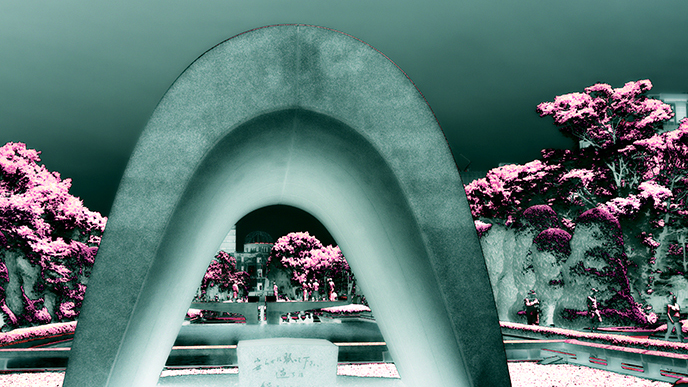


The Memorial Cenotaph in the Hiroshima Peace Memorial Park (visual interpretation by Joe Nalven)
Or simply stand in front of the Atomic Bomb Dome (Hiroshima Peace Memorial) or The Memorial Cenotaph in the Hiroshima Peace Memorial Park. 

Perhaps the President did visit some of these venues ―  in which case we might have similar thoughts.

Whether one is an optimist or a pessimist about the future of nuclear weapons or the unintended destruction of nuclear plants, such as occurred in Fukushima, Japan, it is worth reflecting on this moment in human history and where we are headed.


“Living in a world such as this is like dancing on a live volcano.”  ―  Kentetsu Takamori

Monday, September 28, 2015

Embracing the Centennial in Balboa Park: Trolley Dances and the Digital Art Guild

The San Diego Union Tribune featured 100 stories about Balboa Park to illustrate the 100 years (and memories) of the Park. 

I'm not sure whether other media have chimed in on what makes this Centennial special. Not to mention that we have three months left in the year. There are many other worthy events that add to the Centennial celebration. 

I mention only two. I invite you to add your own nominees to this bouquet of provocative and imaginative displays.

At this time of year in San Diego, we are inspired by the San Diego Dance Theater's Trolley Dances. And this year, nearly all of the dances are in Balboa Park -- from the Zoo Centennial Walkway and Spanish Village to the famous Moreton Bay Fig Tree and the Mingei Museum.


Jill Rowe / Immigrants / featured in the Digital Art Guild's exhibit at Gallery 21
Trolley Dances at Spanish Village / Balboa Park / Back to Front / Choreographer: Mark Haim
The Trolley Dances appearance in Balboa Park certainly qualifies it as the 101st memory - spontaneity, creative use of park space both in open areas as well as in the Mingei Museum, performance in favorite places, and surprise.

The Trolley Dances performed for two weekends - at the end of September and the beginning of October - beginning at the San Diego County Waterfront Park and ending at the Mingei Museum in Balboa Park.

Trolley Dances

The Trolley Dances, performed by the San Diego Dance Theater, has been part of San Diego's cultural landscape now in its 17th annual season.  The concept embraces the urban environment: "Bring dance to the people using public transportation and introduce audiences to new neighborhoods and experiences." 
 
Trolley Dances at San Diego Zoo Centennial Walkway / Balboa Park /  Become Ocean / Choreographer: Jean Isaacs

Trolley Dance at Moreton Bay Fig Tree / Balboa Park /  Roots, Soul, and Love! / Choreographer: Suzanne Forbes-Vierling

Trolley Dances at the Mingei Museum / Balboa Park /  Giving Way / Choreographer: Anne Gehman
And more:  The Trolley Dances at the Waterfront

The dances take the audience to different locations to experience the dances in a variety of urban contexts. This year the starting point was the San Diego County's Waterfront Park (which was formerly two large parking lots on either side of the County Administration building).

Trolley Dances at San Diego County Water Front Park, North Fountain Reflecting Pool / Play(as):  Choreographer: Stephan Koplowitz

Trolley Dances at County Waterfront Park / Blue Stillness / Choreographer: Liv Isaacs-Nollet

If one digs back into the history of Balboa Park, back to 1915-16, one can see the spirit of fanciful design already at work. A.J. Roberts' painted a gondola-filled lagoon with the Park's memorable bridge and California Tower in the background. The painting is now on exhibition at the San Diego History Center. 

That same sense of imagination is reflected in the 102nd memory of the Balboa Park Centennial - the Digital Art Guild's Looking Back, Looking Forward exhibit opening on November 4th at Gallery 21 in Spanish Village.


Digital Art Guild at Gallery 21/Spanish Village

What makes Balboa Park special? Yes, there are the institutional museums, theaters and amazing outdoor organ pavilion.

But there are those smaller niche spaces that invite discovery for the millions that come to the park.

One of those spaces is Spanish Village. Amongst the individual artist studios is Gallery 21. This space hosts a variety of art groups and individual artists - part of an annual juried process.

The Digital Art Guild considered how its exhibit might celebrate Balboa Park's Centennial. There are parks on Alpha Centauri (yes, digital art was borne of varied interests including fantasy and sci-fi, but also ways of reinventing traditional art styles).
  
How best to keep an open mind about the park? The Guild decided on a theme of looking forward, looking back - providing a sense of continuity from the deep past into the unknown future.

Looking Back, Looking Forward provokes the visitor to imagine what the park has been, what it is and what it might be.

The Digital Art Guild exhibit runs from November 4 to November 16, 2015.   

Open daily from 11 am to 4 pm. Artist reception, Saturday, November 7th from noon to 4 pm.

Tony Velez / Games of Emotion (Left) / John Valois / Park Muse (Right)

What comes to mind for a digital artist? Perhaps not that different from what many artists experience - though the tools and style may.

Tony Velez speaks for many of us:   "I am passionate about light, color, nature, music, and love. The artwork that I create is balanced against the hectic pace of my work and reflects my own personal journey of soul recovery and spiritual development. An unusual life creates an unusual artist. I take chances and ask you to feel something inside as you reflect on my pieces. I love what I do.  .  ."


Robert Pendleton / Wish You Were Here  (Upper); Charlie Anne Breese / Spinning Fire (Lower)

Richard ChauDavis with ACE / I See You (Left); Ron Belanger / Bowling at New Balboa Park (Right)
Having been a digital artist for more than a dozen years, I have been thinking about extending 2D flat images - those paintings, prints and photographs - into the ever popular dance video. Over the past six months or so, I've produced two such videos (yes, with much help from others). Both deal with the Genesis story about the first man and first woman. We are quick to say Adam and Eve, but there are myths about another woman before Eve, namely, Lilith. I've played with a conversation between Eve and Lilith - sometimes with Adam and sometimes without. Both videos will be shown at the Looking Back, Looking Forward exhibit. 

You might wonder whether I've taken more poetic license than I should:  Isn't this exhibit about Balboa Park?  Well, for us, that is our own Eden, our own Garden. We can only imagine what happened on these grounds before and the conversations that emerged.

Joe Nalven / What Becomes Eden (premiere) / screen shot of dance video at Gallery 21
 

Monday, August 17, 2015

7 billion Others: The dreams and fears of humanity plus an agenda

The selected stories of thousands of individuals in 7 billion Others illustrate themes such as Being at home, Family, Fears as well as Nature and Climate voices.

These stories from across the world resonate with the class I teach on cultural anthropology. They invite the students, and indeed us all, to listen into the lives, the hopes, and dreams of the human condition.


When you experience this well-designed video installation, keep in mind a caveat:  There is a point of view of the project developer, Yann Arthus-Bertrand - part climate change ideologue and part wealth redistributionist. The latter theme will be the focus of his new movie, Human. The upcoming movie echoes themes voiced by Godfrey Reggio in his trilogy about developed and underdeveloped countries and a world in chaos:  Koyaanisqatsi, Powaqqatsi, and Naqoyqatsi (the Qatsi trilogy).

You may well agree with Bertrand's perspective - or not. But in either case, his perspective ought to be transparent to the visitor.

The Museum of Photographic Arts orients itself, in part, as a center for visual learning. To avoid the problem of subliminal or social-action bias, MOPA could install an informational kiosk that plays short videos explaining the alternative perspective. So, for example, one can be for fighting pollution with or without assumptions about human-caused climate change.  Or, one can be for lifting individuals out of poverty while arguing that any success is due to capitalism or to socialism. From a pedagogical perspective, one should present alternative narratives so that one can judge if the photographic narrative is overly narrow or excessively broad in understanding what affects the human condition. The Museum may state it is only interested in the art of photography; yet this particular exhibit, and others before it (Prix Pictet 2012), espoused agendas for social and environmental change that fit a partial understanding of these phenomena. The issue of a lack of transparency will be explored further in the comments below.


Climate Change Perspectives:  True believers versus Realists

Many scientists and politicians argue that the science is settled: humans affect climate (note that 'affecting pollution' is often confused with 'climate,' but the distinction is an important one). Let's call those who believe that humans affect climate in a significant way the true believers since their minds are made up. Many other scientists and politicians are skeptics (which is the bedrock assumption of science): humans may affect climate, but show us the data as well as the various computer models that massage the data. Let's call this group the realists.

You may find yourself in one group or the other, but the question is one of pedagogy. How should one teach this subject matter, especially with photographs and associated text as narrative? It ought to be a startling and open-minded adventure. The problem is that myth-making and news hype get in the way. Recall the prediction that human caused climate change would cause an increase in seasonal hurricanes? That proved to be unsupported with seasonal hurricanes being far, far less. Recall the prediction that the Himalayas would begin to melt in 35 years? That proved to be a typo.

What then? It's time to explore.

In 7 billion Others, the dominant perspective about nature and climate change is: 1) nature is cuddly (few, if any, talk about hurricanes, volcanoes, pestilence, disease, etc.); 2)  and that those who take issue with the anthropogenic view of climate change either do not care or are from another planet.

As one pages through the remarks of individuals from around the globe, the sense is that nature is wonderful and a sense of joy. I happen to agree with that perspective, but I would likely give voice to the terrible in nature as well. If the idea to be conveyed is that nature is something to be cherished, fine. No problem, but say so. Don't carry over the one-sided dimension into the assumed corollary that whenever nature is damaged it is the result of human activity. Yes, the Gulf Oil spill several years ago was the result of human action, but nature has extensive oil seeps as well. And, even then, scientists were surprised that much of the Gulf Oil spill disappeared in the water due to nature's own cleansing process.


From views on nature, 7 billion Others leads to views on climate change. Some individual views do show skeptical positions, but the dominant frame of reference is one of those adhering to human-caused global warming. If you don't believe in global warming, one interviewee claims that you must be from another planet. 


Not only is the question about whether one's belief puts one in the category of being from another planet, those who resist the perceived needed change lack empathy.


It is true that many of us are indulgent in our personal desires, but this extends to those who see themselves as the caring. That sounds counter-intuitive and hard to believe - that those who say they care about equality often act in ways that demonstrate the opposite, particularly if it affects their own lifestyle.

A recent news article reports that several states are underwriting the affluent in buying more expensive electric cars at the expense of the poor; the less affluent are taxed to support the affluent's life style. One can argue that this tax policy benefits us all - we all breathe the same air; but one can also argue that the user should pay, especially so when there is an unfair tax on the poor. Question:  Who should paying for the electric car charging station? Those who use it or everyone, including the less well off who cannot afford electric cars. Again, you may or may not agree with either policy, but that policy and its social costs should be transparent. In this instance, those claiming to care about X should explain how their benefit of owning an electric car actually helps X (who can't afford an electric car) rather than hurts X. 

Perhaps the truck owner loves his truck, regardless of how it impacts the physical environment; electric car owners may think similarly, regardless of how it impacts the social environment.

A complement to 7 billion Others: Creating a dialog
Moving beyond a critique of the views embedded in 7 billion Others, a center for visual learning could include the following brief perspective that challenges the underpinnings of the installation. 

What if climate change is something other than those who would have us fear carbon, CO2 and an assumed rate of temperature change that would bring environmental calamity beyond what nature has done for billions of years?

Patrick Moore, the co-founder of Greenpeace, presents a useful counter-perspective, grounded in science.


What they haven't told you about climate change


http://www.prageruniversity.com/Environmental-Science/What-They-Havent-Told-You-about-Climate-Change.html#.VcYp8LTZXi8


Without a precautionary commentary such as the one by Patrick Moore, the 7 billion Others installation works well as propaganda for its point of view, but not as an informed pedagogical approach encompassing the views of the true believers and the realists. The latter depends on the transparency of the hosting institution.

The producers' description of 7 billion Others
A ground breaking, multimedia exhibition, 7 billion Others brings voices and compelling video portraits from more than 6,000 individual interviews filmed in 84 countries by nearly 20 directors. For its premiere in the United States, the 30-week presentation will allow visitors to identify what separates and unites us by giving direct access to individuals as diverse as a Brazilian fisherman, a Chinese shopkeeper, a German performer and an Afghan farmer. These interviews touch on our most visceral emotions and pose many thought-provoking questions and answers that speak to the human condition.  Created by Yann Arthus-Bertrand 


The Museum of Photographic Arts [MOPA] will continue showing 7 billion Others through mid September 2015.